A Calculus of Morality
Madhu Avasarala, 13 November 2020, Bangalore, India
Link to Google Docs Link to Audio Overview
“A theory is the more impressive the greater the simplicity of its premise, the more different kinds of things it relates, and the more extended is its area of applicability”
― Albert Einstein
I am the person, if any, who controls ‘the motion of the atoms’ according to the Laws of Nature … DEUS FACTUM SUM (I have become God)
― Erwin Schrodinger, On Determinism and Free Will
“Three passions, simple but overwhelmingly strong have governed my life: the longing for love, the search for knowledge, and unbearable pity for the suffering of mankind.”
― Bertrand Russell
Happiness is an expression of the soul in considered actions.
― Aristotle
Man is a part of Nature, and Nature is governed by eternal and immutable laws. It must be just as possible, therefore, to apply the mathematical method to man, as it is to apply it to matter. It must be possible to determine, with the certitude obtainable in the exact sciences, what things are good for man and what means he has for attaining them.
— de Spinoza, Benedictus (The Philosophy of Spinoza, Joseph Ratner)
Moral theory must be based upon man’s (essential) nature; not man’s nature upon (arbitrary) moral theory
— Joseph Ratner in Preface to ‘The Philosophy of Spinoza’
Knowledge, the object of knowledge, and the knower—these are the three factors that induce action. The instrument of action, the act itself, and the doer—these are the three constituents of action.
― The Bhagavad Gita, Chapter 18, Verse 18
- Abstract
- I am looking for a theory of moral action that doesn’t involve any assumptions other than that of the nature of reality.
- I hope to show that all action, and therefore even moral action, is deterministic, in principle – there is no free will and no subjectivity in the moral code for perfect moral action.
- The search for the highest principle is that which is universal and pervades every aspect of the Universe.
- Such a principle is that of Informational Entropy. I explore ideas of evolution of life as pockets of entropy minimization within the overall entropy maximization of the Universe as it expands along gradients of free energy. This itself is underpinned by an even more fundamental principle, that of Least Action. I will show how the will of an active agent can be interpreted as the principle of least action with appropriate choice of the Lagrangian. The Lagrangian here is moral, and can be thought of as a function of moral cause and its effect.
- I shall make use of the Principle of least Action (PLA) which is extensively used in Physics. I shall discuss how apt the PLA is, to be considered as the Will of the universe and determines action. I shall extend the PLA to also cover active agents. I shall call this the Kant-Spinoza Principle of Least Action (KS-PLA). The intent is to have a single principle that covers all agents. The notion of Action as the Will that drives all actions will be proposed.
- I will introduce my self-consistency principle, also called the principle of self-consistency (SCP or PSC). It states that any action of a perfect moral agent shall be non-contradictory with respect to any of its other actions and the nature of its being. These actions must be consistent with understanding of the universe and with methods consistent with the nature of the agent and the universe. The SCP is the extended epistemology of science to include all understanding. My claim will be that no knowledge can possibly be outside SCP, and that the SCP itself is a self-emergent property of intelligent life. Logically, only such a self-emergent principle can underpin moral action since any other principle will be arbitrary.
- An ethical active agent is one which is free but chooses to act as if it were constrained by laws derived from its moral code. Moral perfection is that process where the KS-PLA is the cause and constraint of all actions of an ethical active agent who has complete understanding of the process. I shall call such an agent a morally perfect agent.
- As our universe has only cause-effect with no discernable teleology, it is logical to question the idea of meaning and purpose of life in such a universe. What meaning can there be in a universe which spontaneously emerges along with space and time and perhaps disappears, no matter how long a time this happens over? I propose that once life gets past the immediate problem of survival which provides the ‘lowest order’ purpose to exist, understanding (oneself and the universe) serves to create the ‘higher and nobler’ purpose to exist. Acting as such a morally perfect agent and taking pride in it serves as the intellectual will to live (intellectual purpose in life). I consider this as virtuous living. This is what Aristotle was talking about.
- The emotion that results from leading such a virtuous life is non-contradictory joy which is not of the emotional ecstatic type but that of quiet deep contentment. It is the gradient along such pleasures that provides the potential, the intellectual purpose, for ‘existing, because of understanding’.
- The KS-PLA degenerates into the PLA for Inanimate objects to move in a deterministic manner. We can impute a will that is identical with the Action. The lower animals also move in a deterministic manner as dictated by the KS-PLA with the will determined by and indistinguishable from instinct. This seamlessly transitions over to KS-PLA for moral action.
- Moral humans who have gone beyond the needs of survival, act as moral agents as determined by KS-PLA where the will is determined by the desire to understand oneself and the universe. The ‘Action’ is the desire to understand. The KS-PLA serves to increase understanding by minimizing contradictions using the SCP which is the same as reducing Informational Entropy. This then, is the asymptotic tendency towards ‘godliness’ which is manifestation of the Brahman principle of Vedanta – ‘tatvam asi’ meaning ‘thou art that’.
- Introduction
In this chapter, I will outline my development and devote subsequent chapters to fill in the details. Finally, I will tie all the ideas into a conclusion at the end.
- Motivation
The primary motive to write this is to clarify my own thinking. The ideas of no free will, unitary nature of knowledge, rejection of teleology, definitions of virtue, objectivity of morality, etc., may be odious to many. Most people are averse to ideas that fundamentally disturb their held beliefs. Culture and cognitive dissonance serve to shut out uncomfortable ideas that don’t fit into their existing ideologies. My aim is not directed at such – rather it is to appeal to those very few who hold ideas such as mine but have been unable to arrive at the conclusions presented here.
I always marveled at the beauty of the mathematical constructs and the reductionist progress of Physics. I was struck by how inexorably Physics advances in trying to unite disparate phenomena into a simple whole without using axioms other than those that cannot be denied in asserting anything. I was intrigued by the question and wonder that many great scientists expressed, as to why the universe was so understandable to human beings. Further, I noticed the deep connection between how the Universe is “causal” and the evolution of the human brain through the same ‘causal’ biology. Self-organized matter observing itself through causality – there is no invocation of extra rational powers and dogmas. There is no wonder in this, the brain has evolved specifically to understand the universe. This does not imply teleology, just that to understand the universe you can only do so by understanding cause-effect. In Hindu mythology God is supposed to be self-born and the Sanskrit term used is “Swayam Bhuh” perhaps the only self-emergent god in any religion. God outside of the universe He creates makes no sense since it entails an infinite regression of Gods as explained by Carl Sagan – a God needs to be created by another God higher up or you end up with the contradiction of a God that needs no creation, Aristotle’s Immovable Mover. In explaining the inevitability of Evolution Daniel Dennett talks about the absence of ‘Skyhooks’ implying that everything in Biology happened inside of a closed system (self-emergent) with no interference from an extra-Universal hand unbound by laws of the Universe. Surely, morality, perfection, virtue, etc., must also be underpinned by some such self-emergent concepts?
The other notion is that of Entropy, specifically its formulation in terms of information, uncertainty, and the thermodynamic and cosmological arrow of time. Schrodinger was perhaps the first person who defined life formally as local regions where entropy is decreased by active consumption of low entropy and dissipation of high entropy to the surroundings. We can view the Universe as a domain whose overall entropy is increasing as it searches for an equilibrium, flowing along the lines of (Gibb’s) free energy. During this process, locally, where conditions permitted, life emerged and evolved. Life is more ordered than its lifeless surroundings and can be viewed as local autonomous regions where entropy is actively managed. In the lifeless darkness of the Universe flickering lights of life emerge just as the first stars emerged from the primeval dust and gas. This can be visualized as isolated holes or valleys in a vast upward sloping plateau of entropy. The depth of the valley serves to indicate how much the local entropy was managed to reduce. The best example of such complex life forms familiar to us, the human beings, have evolved by decreasing their entropy to such an extent that they can predict their environment and future actions to a large extent by modeling the environment by learning through a neural network wherein the local informational entropy is decreased at the end of learning and entropy is dissipated to the surroundings as heat and waste material. Rationality can be viewed as just the modality of such a mechanism of learning. Since, the only unchanging substrate in the universe is the fixity of cause-effect relations, it should not be surprising that this is the reference for the epistemology of such learning networks for least entropy. This is perhaps the only way that intelligence bootstraps its way up from noise. Surely, this must be why the universe is so astonishingly understandable?
“Often animates are associated with absorptive processes which are described as self-organization whereby novel properties are gained. Conversely inanimate are often associated with emissive processes which are seen as disintegration whereby old qualities are lost. However, all processes either way obey the same principle that directs any system along least time trajectory of free energy consumption toward balance in the respective surroundings. In other words, thermodynamics makes no distinction between animate and inanimate, thereby dissolving the question about life and its origin as misapprehension.” – [A. Annila, 2015].
2.1A: A mathematical formalism
Different ethical theories can be broadly categorized into the following principal groups:
2.11 Consequentialism
2.12 Deontology
2.13 Virtue Ethics
Even though the systems differ in their philosophy, they have a common principle of having a system of ethical values and a method to compute such values no matter how complete, rigorous, and consistent such a system and method is. So it is logical to first look for a suitable technical language and formalism to frame a system of ethical values and their method of computation in general. I have adopted the principle of least action based on path integrals as it meets all of the requirements and more as will be evident in this development. This methodology uses a generalized ‘kernel’ that can be considered as dependent on the specific system of ethics. My own development in this paper concentrates not only on this type of formalism but also as to why this is used in the sense of being ‘self-emergent’ and inevitable rather than from some axiomatic or categorical imperative or ‘divine revelation’.
- Moral Determinism
There has always been a belief that moral action is ambiguous and subjective, that ‘ought’ cannot be derived from ‘is’, that moral action is not deterministic even if people do have definite ideas about what the outcomes should be given a scenario, even if all may not necessarily agree on the outcomes. However, if one is convinced of the absence of free will for general actions, it follows that there should also be a conviction that there is no free moral will. So, for any individual, there is some process involved in the determination. Explicitly or implicitly, there is a moral code of values used, and computation of value for any outcome, no matter to what extent such a code is understood. The main question is: can we arrive at a moral code that is not arbitrary? The logical way would be to search for applicable self-emergent principles if any exists, and see if a moral code can consequently be derived.
When we see how easy it is for people to disagree on a cause given the same set of facts, it is not surprising that there is almost universal disagreement when we come to a complex issue such as morality. The hope is that if it is only complexity and consequent lack of understanding, perhaps a lucid exposition may help. If it is irrationality at the core, then there is no hope towards convergence of opinion.
- On Free Will
The degree to which any action (including moral) seems determined depends on the extent of knowledge that one has. In the limit where the knowledge is complete, there must be full determination. The corollary is that the action will seem totally random if the knowledge were null. The preceding statement just needs a little careful consideration to be understood and assented to.
Just analyzing the phrase ‘free will’ shows that it is a senseless statement exactly as Voltaire had proclaimed. A will free of any cause is essentially random and perfectly useless.
The first issue is definition. What does it mean by ‘free’? For clarity here, I will define ‘free will’ as acting without any cause whether explicit or implicit.
A morally perfect being with sufficient knowledge will not make arbitrary choices since the freely willed action will be determined by sufficient knowledge. This determinism is no different from what is expected of a passive agent. This is not really a new or far fetched notion – the operating principle of science is just this. I am just including animal action as part of all actions and being ambitious about predictability. Whether complete knowledge of the universe is possible is not important – as long as it is, in principle. It is important to note that complete knowledge also subsumes knowledge of one’s purpose and goal.
A being who has adequate knowledge and determines what the action needs to be but deliberately chooses to act differently (for whatever reason including perhaps to prove to us that free will exists) will be termed unreasonable and will never be considered moral per my definition. The person himself will be so thoroughly disoriented that in time, if such methods were to continue, would perhaps go insane. To act with guesswork or instinct where knowledge is inadequate or non-existent is one thing, to deliberately act unreasonably is a sure recipe for cognitive disaster.
I think it is fair then to conclude that free will is a direct measure of ignorance. Lack of knowledge also subsumes insanity. We can begin to see the link between Action and Entropy!
- Moral Agency
Explicit action of an agent is defined as that action, guided, or actuated, according to principles of some code of values held explicitly. The process is roughly as follows: The moral value of any action is estimated based on its consequent outcome to whatever precision by some explicit or implicit algorithm. An explicit or implicit local optimization (to achieve whatever goals however set) is done over the range of possible choice of actions and a choice is made.
All other than explicit actions of such an agent are implicit, actuated by the nature of the being. In the limit where all actions of an agent are explicit, I say that the agent is consciously deliberate as opposed to instinctive. By explicit I mean that the actuation is deliberate, and the action is chosen. Nothing has been said yet whether the held code of values is ‘good’ or ‘bad’ or and if so, according to what standard – any code will do for the definition. Any agent which can act, we shall term as ‘Active’. Conversely, an agent that does not ‘act’ is a passive agent. A worm is an active agent, a piece of rock is passive. Active and Passive seem synonymous with presence or absence of life.
An example of an explicit action is the conscious deliberate avoidance of having children because one has insufficient means. Another example of an explicit action is to be a vegetarian or a vegan. A further example is to not give your entire fortune to your offspring as inheritance. These are not instinctive actions.
An example of a non-explicit (instinctive) action is promiscuity and to procreate uninhibitedly, driven by the biological instinct to reproduce. There is no thought involved in instinctive actions. Another implicit action is to take on the belief system of the religion you are born into. A further example is to eat the kinds of food you were fed as a child without giving it any thought.
- Moral ‘Advancement’
Humans (amongst other species in the animal kingdom) possess the capability of explicit action. Animals mostly possess instinct. Modern humans generally have limited instinct which is insufficient for survival – Instead, they have a well-developed brain that can assess, analyze, synthesize, and plan. Thus, humans are capable of an infinitely wider range of possible actions as compared to other animals, even other primates. However, not all such actions are beneficial – only a narrow subset (we shall better define what ‘beneficial’ means since that is part of the development in this essay. For the immediate purpose here, ‘beneficial’ can be defined in terms of obtaining basics such as food, shelter, clothing, a suitable mate, etc.).
It is not immediately given as to what governs the selection of such a beneficial subset. In ‘less advanced’ civilizations, culture determines this subset to a large extent. In ‘more advanced’ societies, individuals determine actions based on their personal moral code of values, however that is derived. This moral code can differ considerably amongst individuals and cultures. I shall endeavor to show that ‘advancement’ is the degree to which the laws of a society are consistent with the nature of humans, which is to be rational. I will endeavor to show that rationality subsumes compassion.
My concern here: is there a prescribed method of deriving a perfect moral code? Is such a prescription arbitrary or deterministic? Is it even needed?
Ethics is usually regarded as subjective in that ethical action involving “ought”, seems incapable of being derived from any fundamental axioms in the way that complex physical principles can be derived from fundamental axioms. Crucially, compassion, the concept that should be central to ethics, seems outside the realm of science – sometimes even outside the realm of ethics itself. So, at the outset, it seems impossible to reconcile conventional ethical arguments with the scientific method. The reader may question as to why compassion ought to be crucial to ethics. The answer will be made clear in my development.
- Moral subjectivity
There is a broad consensus regarding (efficacy of) scientific laws, for example: Einstein’s theory of general relativity, Quantum Field Theory, Theory of Evolution, etc., but not regarding moral codes. Why is this? For a detailed description of this problem please see Sam Harris, The Moral Landscape – How science can determine human values for a broad treatment.
I will summarize my simple argument thus: Firstly, science is based on objectivity (that is, Science concerns the observable universe) and all participants are forced to acknowledge this in their debate. Consensus follows experimental verification in which everyone can participate. Secondly, science is not cultural (culture is defined as customs, traditions or knowledge passed down through generations without rigorous justification and resisting change). Science is taught rigorously whereas moral codes are largely acquired culturally. Take for example the 5 major religions: Judaism, Christianity, Islam, Hinduism, and Buddhism. As Lord Bertrand Russel so eloquently put it, given that these religions in the main do not agree with each other, if at all, at most one of them can be true, yet how is that majority of people ascribing to the religion of the culture that they are born into? This is only possible if moral codes are accepted unquestioned on authority or faith but not reason. This (evolutionary pressure for) cultural inheritance of moral codes is evidently very strong and must therefore have been a powerful evolutionary factor. Much of cultural heritage is acquired in childhood as the child’s mind is then most open to programming. This also includes language, music, religion, and food. The Jesuits obviously knew of this:
‘Give me a child till he is seven years old, and I will show you the man.’
― St Ignatius Loyola
This fact largely explains why people practice or inherit the religion that they are born into. This report by the Pew Research Center says (of India) that 99% of people born as Hindus remain Hindus, 97% is the number for people born as Muslims and 94% is the number for people born as Christians. You can see the power of ascription of practiced religion and culture, into birth. If that were not the case, the conversion numbers out of a religion should be all over the place rather than close to 0%. You would also expect that the more dogmatic a religion, the more the conversion out of it. However, the numbers tell a different story. So, adoption of religion is not because of reason but cultural, ascription by birth.
Because of this, most human beings are an odd mixture of rationality and (inherited) culture. They may use science for work, medicine, travel, etc., while they may mostly use culture to guide their beliefs and morals. (Jay Gould famously mentions this as “Non Overlapping Magisteria”). If they see any contradictions in doing so, they suppress them. This suppression creates a psychological stress or discomfort that is termed cognitive dissonance. Since objectivism is denied entry via culture to influence their beliefs and morals, a subjective element enters their moral codes. This is the root cause. The disagreement about values amongst the various moral code holders can often be very vehement leading to violence as evidenced by religious wars and oppression of free thought, some glaring examples being the burning of Giordano Bruno at the stake and house arrest of Galileo, the Islamic religious depredations, The catholic inquisition, slaughter of Hugeonots by Catholics in France, the genocide of the Jews in the holocaust by the Nazis, etc. History has shown the enormous violence caused by Judaism, Christianity, Islam, dictators, and communists against people who disagree with them. While not in the same class (in terms of scale of violence) as the other religions, Hinduism has oppressed people by discrimination, by sanctioning the caste system, and the usual oppression of women and non-heterosexuals. Of all the major religions, Jainism and Buddhism have perhaps the best historical record of being the least oppressive. In the case of Buddhism, the fact that it has the least dogma of any of the major religions must surely account for this.
Even today, atheism is punishable by death in 13 countries (Afghanistan, Iran, Malaysia, the Maldives, Mauritania, Nigeria, Pakistan, Qatar, Saudi Arabia, Somalia, Sudan, the United Arab Emirates and Yemen), all of them Muslim (Discrimination against Atheists, Wikipedia).
There may exist disagreement due to inexact or improper utilization of knowledge but that is minor, and agreement can be reached with proper dialogue. I am only concerned here with disagreement due to fundamental differences in values itself.
So, the situation seems hopeless then and there is no remedy? Not quite, there is a remedy, and it is used by scientists in their work every day of their life: Reject the view of people who are not objective and who do not subscribe to scientific methods in all endeavors of life including morals. Just as proper knowledge rejects irrational ideas, a proper moral code must also reject irrational ideas.
Read the excellent essay on mysticism by Lord Bertrand Russel where he argues how mystics wrongly misinterpret intense longed for emotions as revelations and knowledge which were precursors to revealed religion.
If you look at the world at large you will notice that it is almost evenly distributed along 2 sides of any principle: Democrats/Republicans in the USA, Muslims/non-muslims, BJP/Congress in India, Left/Right in almost any country in the world. Each thinks they are in the right and the other wrong. Throw in fascism (Russia, China, N. Korea) and theocracy (Muslim countries) and you get a very unstable situation ready to explode. The reasons for the variability in morality are:
- They have different moral codes (due to religion, culture, etc.)
- They have the same moral codes but are unable to evaluate values correctly due to poor understanding.
- They do not have any explicitly held moral code, coupled with possibly poor understanding.
- A combination of the above.
Let me give a few examples of how some of these mixed moral codes might work in practice:
- A religious scientist (The best example of an oxymoron)
We know of highly intelligent scientists (such as Isaac Newton, James Maxwell, etc.,) who were religious. These people were extremely careful about being objective when it came to their work but inherited and accepted without question the faith practiced by their progenitors/culture. Such people must compartmentalize their work and faith since they are contradictory (for example the miracle of virgin Mary is accepted, and with it all the religious dogma that goes with the religion, whereas no miracles are allowed in their scientific work). Such people surely do not have an integrated view of existence such as for example how Albert Einstein or Bertrand Russell or Carl Sagan did. Since religions inflexibly and arbitrarily (non-objective) specify their moral code, these people necessarily subscribe to such moral codes even if it means that these moral codes are unjust and cruel (for example: heretics and witches should be burned at the stake, animals are created by God for use by humans, etc.) Such people are internally tormented by contradictions that they desperately but vainly try to reconcile (Cognitive dissonance). This contradiction will torment them, the more they try to be perfect, the more sensitive they are. Even the seemingly benign dogma such as the trinity of Christianity caused a great deal of angst to Newton! Other scientists such as Pascal and Leibnitz also compartmentalized their thinking. Please read Voltaire for destructive commentary on views of both these scientists. See for example, Pascal’s wager and Best of all possible worlds. Of course, you can read the classic, Candide, by Voltaire for an excellent satire on “The best of all possible worlds” as remarked by Leibnitz. To do justice to Leibnitz though, he could be considered correct in his remark if he meant it ontologically and not teleologically. All Leibnitz had to say was that the creator was dispassionate, and the word ‘best’ would then have had no moral connotation. But Leibnitz did mean ‘best’ in the moral and teleological sense for humans and Voltaire immortalized this through the parody of Pangloss.
- A scientist working for oppressive regimes
A scientist working voluntarily for an oppressive aggressive country such as Pakistan, North Korea, Iran, China, Russia, etc.: In this case the scientists are guiltier than the dictators of such countries. The dictators are depraved people, but the scientists have some vestige of truth, the truth and objectivity used in their work. They succumb to the cultural and jingoistic platitudes and fail to see the intellectual treason that they are committing by furthering such regimes. Technology is amoral and can be used for good or bad. These people choose to use technology for bad ends and give a bad name to technology. In this context see how moral were the great German jewish scientists that fled Hitler’s Germany and contributed to the making of the Nuclear bomb in America.
- Meat eating “animal lovers”
People who claim to be spiritual and or kind but eat meat and ignore the suffering of animals. This is a bad joke – these people forget that the essence of spirituality begins with the feeling of the oneness of all creation. Evidently, this oneness is presumed to include only humans (in many cases even smaller subsets such as only humans from their religion or worse, only men from their religion) as in the case of devout Christians, Muslims, Jews, Zoroastrians, Buddhists, and Hindus who happily eat meat. Anyone who eats meat or harms animals has no right to the words ‘spiritual’ and ‘kind’. Of these groups, the Hindus and Jains have the highest percentage of non-meat eating but on the other hand due to their ignorance and poverty, their treatment of animals does not have a good record consistent with kindness. The Buddhists are the worst, in that the central tenet of their religion is ahimsa which can be translated as non-violence to all living beings – yet the percentage of vegetarians amongst Buddhists is very low. It is almost impossible to find vegetarian food in countries like Singapore, Thailand, Taiwan, and Hong Kong, where Buddhism is the professed religion of the majority. (When I traveled through Tibet, the only way I could eat vegetarian food was because we carried our own food). Consider that the highest pontifical authority in Buddhism, the Dalai Lama eats meat. When asked about the contradiction, his lame answer was: “the doctors have advised me to do so!”
2.6.4 ‘Liberal’ Intellectuals @TODO
- Knowledge
I define knowledge as a model one builds, to predict and understand the Universe:
- with the least possible complexity
- that can make verifiable (and falsifiable) predictions, even if only in principle,
- which is available to all who may care to make the effort
(This definition is somewhat like the verification principle that A.J. Ayer proposed in his ‘Language, Truth, and Logic’).
All knowledge must be subsumed under this definition – there is no other known mechanism of obtaining knowledge. Given this, why the lack of consensus on ethical knowledge since it must also be a subset of the knowledge of the universe? The lack of consensus must only arise due to the complexity of the issue and lack of adequate understanding or subjectivity in the value system. (The only other possibility is that the definition of knowledge as given above is not acceptable – I do not address that question, as I deem that literally senseless and not amenable for discussion.)
The concept of the supernatural is senseless by my definition of knowledge. Nature, the Universe, encompasses everything. What is in Nature may be knowable but what is outside Nature is undefined, unknowable, so no claims can be made on it. The claim of spiritual knowledge (that it is special and outside the realm of material knowledge) I shall dispose of in a similar vein: since it is subjective (unverifiable even in principle), no claims can be made on it. This is not different from the stance taken by logical positivists in dismissing metaphysics. For my purpose here, I take a similar stance – if a claim is not verifiable even in principle, it is literally senseless, at best speculative. I understand that a large section of ethical theories is thus dismissed – I say, rightly so! An ethics based on duties, commandments, or categorical imperatives is arbitrary and to be rejected.
Another popular category is supra-rational knowledge. Here the claim is that this ‘knowledge’ is superior to rational knowledge. This claim is trivial to dispose of – any superior knowledge must subsume all that it claims to be superior to. Supra-rational ‘knowledge’ can make no seamless transition from objective knowledge to the claimed superior domain, since it is incapable of making verifiable predictions in the ‘lower’ objective domain and so can be easily dismissed.
The aspect of ‘objectivation’ as was raised by Edwin Schrodinger in chapter 3 of his book ‘What is Life?’ is a serious question in the light of the discussion above and needs to be answered. In brief, since all knowledge of science or objective knowledge presupposes an external observer and the observed universe, whereas they are both in the same universe, whether there is a (different) domain of knowledge accessible when such a partition is absent (for example when making a measurement in quantum mechanics without breaking quantum entanglement). This question has not been answered as far as I can tell. However, I can offer a speculative answer: I feel that the objective way of studying and understanding the Universe is an intellectual effort and needs the intellect to operate as it normally does when doing science. The case where the partition between the observer and the objective world is absent (they are ‘quantum’ tangled in some undefined, as yet unknown way) is no longer an intellectual state but a state of pure being or feeling. There is a oneness with the Brahman so to speak, and no differentiation is possible and hence no learning. The crucial part is that, ecstatic as this state may be, it is not a state of knowledge but only of pure being. So, there are no privileged regimes of access to knowledge other than the objective one of science. Even if we admit hypothetically that any such were possible, they will still have to make verifiable predictions of the universe and this case then is no different from that of the so-called supra-rational knowledge. Schopenhauer was right when he said that it is only through Art that we can directly (emotionally) access the universe or be one with it. Otherwise, one can understand nature only intellectually.
- Perfection and self-consistency
Observe that (only) a tiny subset of human beings asks themselves the question, every time they undertake any action: Am I doing the right thing? – why does it matter whether the action they wish to undertake is ‘right’? Their typical answer is that it is a question of integrity. This is a powerful clue.
Integrity is the practice of being honest and showing a consistent and uncompromising adherence to strong moral and ethical principles and values. In ethics, integrity is regarded as the honesty and truthfulness or accuracy of one’s actions.” Wikipedia. Another definition is also being whole or unbroken. I will be using both these definitions.
In pursuing this and related clues I should be able to build a moral theory which requires nothing other than this acknowledgement – that rationality is the essential nature of humans. By tying the emergence of reason and rationality as the result of the process of Evolution that itself is based on cause-effect, will ultimately enable me, at least in principle, to tie rational ethics to science.
If we take the ‘lower’ animals, ethical behavior is equivalent to self-preservation and perhaps, to a lesser extent, kin preservation. There is very little room for anything other than instinct, which is the a-priori of genetics due to evolution. This is a very powerful force for survival without which life would have extinguished itself. So, we need to give it careful thought.
It is only with the advent of rationality in the ‘higher’ primates that thought has been given by them about what is ‘right’ action since many different avenues of action are possible in each circumstance and there may be a desire to do the ‘right’ action. Where does this desire originate from, that is not there in the lower animals? Is this a desire for ‘Perfect (moral) action’? What is the definition of Perfection? What is the root cause of this desire? Seemingly, this ‘Perfection’ is not too different from the desire to be virtuous of the early Greeks (Aristotle). They ascribed the seeking of Virtue as an End. I propose that this desire for ‘Perfection’ is the affirmation of one’s self-worth, to give one ‘a purpose and the will to live’ and is tied to the concept of integrity. This ‘will to perfection’ supersedes the instinctive will, beyond a certain stage of learning and experience. It is easy to see how religions co opt and subvert this to implant ‘their ‘God’s Will’. In my development I will tie all to Nature so that nothing is arbitrary. I do parallel Spinoza in my aim, but the justification is different.
Every action is associated, indeed, caused, by some will.
I argue that issues regarding movement of inanimate objects are not fundamentally different to the issues associated with movement of animated objects. (Similar observations have already been made, for example by Spinoza and Voltaire). In the case of voluntary movement of animated objects, the movement is directed by the will of the animated object. This will is a function of external inputs and the nature of the animal. In the case of the movement of inanimate objects, the object moves because of forces external to it. However, if the forces and the movement are considered as a whole, as in the Principle of Least Action, a ‘will’ of nature emerges that resembles the will which motivates the voluntary movement of an animated object. I shall use this principle and use the nature of such an emergent ‘will’, to assert that in the limit, as uncertainty of knowledge tends to zero, free-will disappears, just as for an inanimate object. Then all action is perfect action! This view of lack of free-will is not new but the wider synthesis presented here is.
If the history of ethical practice of humans since the dawn of civilization is examined, it is evident that on average, there is a certain direction in the moral landscape. Broadly, the tendency for the evolution of morality has been for the betterment of all of humanity and not just a narrow subset. Let us call this direction ‘advancement’ – we may also use the term ‘upward’. I will attempt to describe the direction of the arrow of such an ‘advancement’ of ethics and use the provided clues as constraints or axioms to my moral theory.
My aim is to arrive at a principle using which a rational (human) being will consider an ethical action to be that which is self-consistent. By self-consistent I mean that any action done by such a person is consistent with everything else done including the very nature of the person, the associated knowledge, the goal, and the nature of existence itself – there is no contradiction between the nature of the person and the actions done. From such a beginning, compassion and an Action principle are shown to be inevitable. The degree by which any action deviates from this shall be shown to be due to the degree of imperfection in understanding. The degree of understanding and self-consistency is the measure of moral perfection. There are no axioms, just a self-emergent self-consistent theory bootstrapping itself all the way from noise to its full complexity.
For any action, notice that it is common for people to ask: What is the reason? The motive? This already gives us an idea that there is an expectation that actions must be motivated, and the motive usually is attributed to ‘some’ reason. Note that even the courts of law look for a motive for a crime. A motiveless crime is termed senseless and done by a ‘mad’ person. I will develop this to the highest pitch possible. In our development the motivation will be due to the nature of the being (rationality) and curiosity of the Universe since so little of it, including the purpose, is known.
Note that contemporary moral theories accept different actions based on the free will of a person. My statement that a person’s free will evaporates (and converges to some universal Will) as the understanding increases, implies that moral action is severely constrained – meaning that there is no subjectivity, all people seeking perfection are forced to accept the theory, which I claim is self-emergent from universal causality.
Apart from any reality of it, there is an aesthetic in contemplation of such an ethical concept – Spinoza postulated the natura-naturans and the natura-naturata, Schopenhauer the Will, and the Hindu Vedanta the Brahman – all posit the view of free will concomitant with ignorance and that under full understanding every object and being is forced to acknowledge and act according to the supreme Will or governing principle which is also part of the system, and bound by it, not outside of it – Then you get the Tat Tvam Asi used within Hindu and yoga philosophy to refer to the unity of Atman (the individual self or soul) with Brahman (universal consciousness or the Absolute) literally ‘You are that’. This is what Schrodinger refers to as DEUS FACTUM SUM (I have become God) when a knowledgeable being acts in accord with the Universal will in perfect understanding. This is not religion! This is Science and the emotional feeling it gives rise to is the experience of spirituality.
The only issue is – what is such a governing principle? We have given the clue that it is perfect understanding but we shall attempt to answer it in detail in later chapters.
There is another interesting aspect to this (by deriving all actions by means of the Action principle) – that of invariance, symmetry, and conserved quantities by way of Noether’s theorem. All higher Physics is about invariance (that phenomena are fundamentally unchanged, independent of the observer’s reference frame) and symmetry. For example, Newtonian mechanics is Galilean invariant, the theory of Special Relativity is Lorentz invariant. Any deep, fundamental principle should be invariant upon changes in points of view. Einstein went to the ultimate step by inventing ‘general covariance’ to completely generalize phenomena independent of an observer’s viewpoint (coordinates, whether stationary, moving with constant velocity, accelerating, or freely falling in a gravitational field). I don’t recall ever seeing a system of morality bother to invoke this important tool to try to firm up its essential tenets. There is no invariance principle or ‘general covariance’ aspect, in any moral theory that I have come across. Ethical systems have mostly arbitrary axioms (dogma). This is my only original contribution – rather than viewing Invariance as a fallout, it is essential to view Invariance as necessary to moral theory and see where it leads us, just as was done in Physics. We do this because we have made improvements in practical moral theory only by making things at least locally invariant such as sex/race/nation of origin/color/sexual orientation/etc.
What we need is a crisp theory of ethics using some such Invariance principle and a lucid but terse application of it along the style of A.J. Ayer’s principle of verifiability. My ambitious aim is to do just that. I will call such an ethical invariance as Kant-Spinoza Invariance (since that great philosopher, Spinoza, was so fond of couching ethical statements as geometric theorems, he would have appreciated the spirit of my effort – and Kant because even though his moral theory had flaws many of his moral views were lofty). So, any valid moral theory shall be KS-invariant just as anything in general relativity is Lorentz Invariant and Newtons’ Laws are Galileo Invariant.
By using our KS-invariance, most if not all religions will be rendered literally senseless. Racism, oppression based on claimed racial inferiority, cruelty to animals, all would be mitigated or eliminated in a single stroke. Simplistically, any action of an individual not harming anyone, should be allowed as only the business of the actor and no one else.
Undoubtedly, to compute the value of any action using the principle of self-consistency will be a formidable task. But we implicitly do computations when we make decisions. Are they accurate or approximate? Undoubtedly, they are highly approximate according to whatever system of values even if vaguely held. So, we can at least do better than that! Even if we get the directionality of the action right and minimize the noise and bias in the computation, that itself is a big thing. (Read Daniel Kahneman’s book on Noise to understand noise in judgment)
In much of all that follows, instead of getting bogged down in hair-splitting metaphysical discussions, in the spirit of A. J. Ayer’s verification principle [4] and Merwin’s ‘shut up and calculate’ remark when asked about the Copenhagen interpretation of quantum mechanics, I will try to offer tangible solutions that perhaps can be calculated and affirmed or denied.
- Ethics
The first question to ask ourselves is: do we need an ethical theory? And if so, do we also need an ethical theory where only the individual is concerned, or only when it concerns a society of more than 1 individual?
- Is Ethics required in a society?
Obviously, the answer is ‘yes’. As will become clear later, suffice to say here that since an ethical action of any individual can potentially impact another sentient being and a society does have multiple sentient beings, we do need an ethical theory when living in a society. A system of law codified according to this theory will benefit all sentient beings living in such a society. Such a law should not be arbitrary and should progress along an index that is tied to a computable self-emergent value system which itself will evolve based on increasing knowledge. Without an ethical theory and a corresponding system of law, no civilized life can exist. Since this is self-evident, I shall not spend any more time defending the need for an ethical theory for a society of human and other living beings. It should be self-evident that the evil and suffering we see today is due to the lack of a global law based on a rational ethical system. Evils as for example:
- Slavery and trafficking
- Inequality (of rights not wealth)
- Violence and abuse (Women, children, Homosexuals, Transgenders, animals)
- Lack of Animal rights, cruelty to animals, meat eating, animals used for research, etc.
- Denial of Climate Change
- War and aggression by individuals, groups, and states
- Is an ethical theory required for an individual?
The answer is not obvious in this case since an individual’s action need not impact any other sentient being. But it does impact the agent! So, the ethical theory here is a degenerate case and essentially becomes a tautology of the purpose of the individual for living in this universe. In cases of doubt, it reaffirms the individual and reminds him of the nature of self and things and helps clarify the complex issues involved for a purposeful life. For example, when all your material goals are achieved and needs are fulfilled and you wake up one fine morning with ‘a divine discontent of soul’ and ask the despairing question: why should I continue to live, since I am not motivated? you will get answers. We shall talk more of this in our conclusion where we will tie up all our threads into a logical whole.
- Direction of the Arrow of Progress in Science (Physics)
It is well to look at how knowledge of science itself has progressed from the particular and local, to the general and universal. Take for instance, physical laws describing motion: The initial version was how Newton originally phrased it, the rate of change of momentum is equal to force applied externally. Perhaps, even before Newton, that of Galileo. Before Newton there were no systematic laws of motion. While Newton’s Laws of Motion are still valid, they are not general and only approximate – they depend on the observer, and furthermore, they postulate absolute time and space along with simultaneity which manifestly do not exist. To make it both space invariant and time invariant it must be couched in terms of a relativistic Lagrangian using the Action principle (explained later in chapter 7). This was done in progressive steps due to successive efforts of Maupertuis, LaGrange, Einstein, Minkowski, and Lorentz, amongst others. It took several hundred years for this to happen. A further advancement was to invoke the equivalence principle using the covariant derivative (Albert Einstein). This made the laws of motion general, and the special privilege given to gravitation was removed – gravitation was nothing other than the motion along a geodesic resulting from any curvature of space-time. Each of these invariances revealed finer structures of our universe: For example, in the case of special relativity, time is just another dimension of space-time. In the case of general relativity, the universe can be modeled more accurately accounting for bending of light due to gravity, the gravitational redshift, gravitational lensing, etc. This also enabled us to model the expansion of the observable universe using the Lambda-CDM model of Cosmology. In fact, the generalized treatment of Quantum mechanics only became possible (originally due to Dirac and enhanced by Feynman with the path integral and Feynman diagrams) after applying invariant forms of dynamics and quantizing the Hamiltonian resulting in Quantum Field Theory (QFD).
An immense benefit of using the Lagrangian and the Action principle (PLA) is that underlying principles regarding conserved quantities automatically emerge. For example, early on, the conservation of energy, linear momentum, and angular momentum were observed and conservation principles postulated empirically. However, from the Action principle and Noether’s theorem, these conservation relations emerge naturally – there is no need for empirical postulates. This shows that such a synthesis is ‘higher’ in the sense of Occam’s razor – the number of disparate models in the theory have reduced and more concepts have been unified.
This type of progression, a wider unification of knowledge, is the goal in science and so also to be expected in ethical knowledge. In Physics no new theory is entertained seriously if it doesn’t satisfy the principle of invariance. We can therefore talk of the time arrow of advancement of physics as an ongoing unification of disparate physical phenomena into a single comprehensive model (with minimal axioms and variables that need tuning), that is verifiable and falsifiable by observations of the universe. The Standard Model of Physics is such a comprehensive model. The theory of General Relativity is another. Effort is on to unify these and is the current ‘holy grail’ of every physicist.
Similarly, the Kant-Spinoza moral invariance principle postulated here is a guide for our own search for a comprehensive unified ethical theory. In ethical theories much of the inconsistencies arise precisely because of biases, privileged viewpoints such as chosen people, chosen race, chosen religion, chosen species, chosen planet, etc., coupled with arbitrary categorical imperatives.
- Direction of the Arrow of Progress in Ethics
Let’s see if there is any direction in which Ethics has evolved over time. As will be argued here, there has been a direction in the evolution of ethics – more uniformity and inclusivity, just as was the case in Physics as was discussed in the previous chapter.
In early times, one’s tribe was regarded as the special chosen one by ‘god’ and all others outside of it would be treated differently. Over time, tribes gave way to religions. Adherents of every religion thought they were the chosen ones and outsiders (infidels) could be dealt with differently. City states and countries began to be formed and outsiders were considered enemies and could be treated as slaves if conquered. In all these cases the women were mostly treated worse than men and with little or no consideration to animals.
All over the world, even in Ancient Greece and Rome, war, pillage, rapine, and slavery were rampant. Outright slavery existed almost till the end of the 20th century.
Even the most noble constitution of the United States of America as framed by Jefferson, was early on, interpreted to apply only to white males – it was only in the early 1900s that women got a right to vote. It was only in the 1970s that African American people began to be treated on par with the whites. Here is a chart of the degree of American slavery over time – I have arbitrarily given a value of 0 for slavery, 10 for segregation and 100 for freedom.
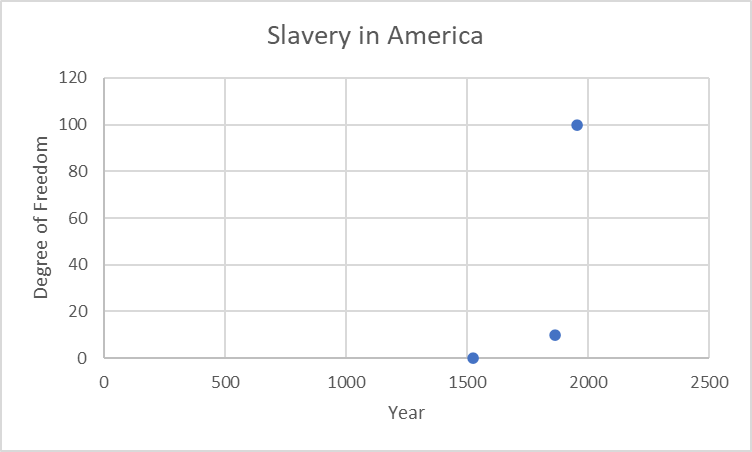
You can see the almost exponential nature of reduction of slavery or looking at it differently, rise of ethical treatment of Citizens in the United States (race asymmetry).
In Switzerland women citizens only got the right to vote recently (1970s). Even to this day, in many countries, men who marry can bring their foreign wives to be naturalized but women don’t have similar privileges. (Gender asymmetry)
Animal rights never existed anywhere except perhaps (loosely and inconsistently) in India, where, due to Jain and to lesser extent Buddhist influences incorporated into Hinduism, the Ahimsa concept protected many animals even though meat consumption was not hindered. An astonishing 37% of Indians are vegetarians compared to less than 5% in countries of non-Hindu religions. I would argue that this is the single greatest contribution of Hinduism (and Jainism). More than 300 million Indians are vegetarians for moral reasons (influenced by Hindu culture) – compare 37% with 5%! If we assume the population of the planet in 2023 to be roughly 8 billion people, 5% of 7B would be 350M, 37% of 1.3B is 480M! There are more vegetarians in India than in all of the rest of the world! India is a very great country even from just this single point of view!
Animal rights are mostly non-existent even though the higher animals can experience pain not too dissimilar to that of humans. Thousands of monkeys, chimpanzees, and other animals such as dogs, rabbits and mice are subjected to ceaseless pain in the name of medical testing, research, and products derived from animals. It is only in recent times that we have organizations such as PETA and Physicians Committee for Responsible Medicine (PCRM), battling to make animal rights an issue. The PCRM is remarkable in that it consists of (science trained) physicians who wish to take an ethical stand beyond cultural influences.
Clearly, from a situation of having no clear concept of ethics at the dawn of human history to now, there has been ‘progress’. Starting with invariance with respect to tribe, then religion, then country, then race, then gender, then sexual preference, and now slowly non-human animals.
This progress is so firm that for modern humans it is difficult to imagine that ethics could be dependent on one’s gender or country or race, since they are only familiar with the current situation.
Notice that even amongst animals there is a clear bias – Pets such as dogs, cats, and animals used for recreation such as horses, are treated very differently from other animals even though closely related. The cow and the pig are not different from the dog and the horse, but the latter is not eaten but the former is relished even. If these humans were intellectually honest, they would acknowledge that this choice is specious and arbitrary. Meat eating humans who claim to be compassionate, and lovers of animals, close their eyes when it comes to eating meat. I shall not admit a claim that eating meat is a compassionate act by any stretch of reason.
Here are the 10 most ruthless facts about animals as stated by World Animal Foundation:
As Per 2021 Stats, Annually Almost 83 billion Animals Were Killed Worldwide
- More than 100 million Animals Are Killed Each Year by Hunters in the US
- Almost 1.5 billion Cows Are Killed Each Year
- In 2021, 34.36 million Cows Were Killed in the US for Food
- Around 3.5 million Pigs Are Slaughtered Annually
- Globally More than 73 billion Chickens Are Slaughtered
- Almost 2.1 billion Wild Fish Are Caught and Killed Every Day for Food
- Per UN FAO, annually about 1.2 billion rabbit are slaughtered just for meat
- Almost 749 million Geese and 52 million Guinea Fowls Are Killed Annually
- In 2021, More Than 500 million Goats Were Slaughtered for Food
- More than 20 million Animals Die Annually in the US On their Way to Abattoirs
We have not accounted for the animals that are ill used for other than food such as cosmetics, clothing, medicines, medical experiments, etc. Even if the numbers are not absolutely correct, even a fraction of this is horrific! The scale of systematic destruction of life!
Clearly, we have not even started with animals – we have all the way to go.
If we extrapolate this tendency of progress of ethics, we can predict that in some future time it will be unethical to cause pain even to autonomous robots and that all forms of suffering of animals caused by humans will cease and that ethical norms will forbid eating of meat. In the distant future (as first postulated by David Pearce) it is quite possible for humans to actively intervene into the animal kingdom and replace or at least reduce the dependence of the food chain that causes so much angst among the animals.
In summary, we can argue that the arrow of ethics points in the direction of decreasing sentient pain. If this is correlated with the direction of the arrow of knowledge, we can see that increased ethical behavior encompassing more of the sentient world correlates to increased knowledge and decreasing entropy.
Clearly, this arrow of ethics is not linear but almost exponential with time. Since knowledge is also exponential it is not coincidental that these go hand in hand. The one will lead to the other. Ethics and knowledge go hand in hand.
- Requirements for our ethical theory
- Starting from Physics
The way that the most general, profound, and far-reaching conclusions of Physics have come about is by taking the epistemic stance of invariance. The stance is that the Universe is fundamentally understandable and that its profound laws should apply universally. This means that the laws do not change by place, time, viewpoint, etc. This insistence is not arbitrary but based on the SCP (Self-Consistency-Principle).
For example, the rule describing Newton’s force of gravity between two chunks of matter is the same whether they are in this galaxy or another (translational invariance in space). It is also the same today as it was a million years ago (time invariant). The law does not work differently depending on whether one chunk is east or north of the other one (rotational invariance). Nor does the law have to be changed depending on whether you measure the force between the two chunks in a railroad station or do the same experiment on a moving train (Galilean invariance) or on a space rocket (Lorentz invariance).
Another example of a physical invariant is the speed of light under a Lorentz transformation and time under a Galilean transformation. Such spacetime transformations represent shifts between the reference frames of different observers, and so by Noether’s theorem, invariance under a transformation represents a fundamental conservation law. For example, invariance under translation leads to conservation of momentum, and invariance in time leads to conservation of energy. Energy and (canonical) momenta are linked by the Lagrange equation.
Invariants are of the essence in modern theoretical physics, and many theories are expressed in terms of their symmetries and invariants. Noether’s theorem states that every differentiable symmetry of the action of a physical system has a corresponding conservation law.
Covariance and contravariance generalize the mathematical properties of invariance in tensor mathematics, and are frequently used in electromagnetism, special relativity, and general relativity.
In theoretical physics, general covariance, also known as diffeomorphism covariance or general invariance, consists of the invariance of the form of physical laws under arbitrary differentiable coordinate transformations. The essential idea is that coordinates do not exist a-priori in nature, but are only devices used in describing nature, and hence should play no role in the formulation of fundamental physical laws.
What invariance or general covariance does is remove any local bias from physics. There is no ‘privileged’ place, coordinate system, observer, etc. Note that this is an epistemic stance used to initially postulate (widely applicable) theories that are to be verified by empirical data ultimately, to be accepted as knowledge.
The other key aspect of our epistemic stance is that the universe is fundamentally understandable. Many philosophers and scientists have confessed that they find this deeply mysterious. My own view is that the human brain has evolved only to understand the universe (even though the primary reason is perhaps to survive and multiply better). Since the human brain has evolved for observation of complex cause-effect patterns and since the universe is cause-effect in play, it should not be mysterious that the universe is fundamentally understandable. The (animal) learning systems have evolved for the precise purpose of modeling nature in order to reduce uncertainty for better fitness for survival under changing environments.
I will use this concept of invariance and the fact that the universe is understandable (without recourse to non-objective means) in developing our system of ethics. The great Immanuel Kant was the first one who tried to formulate a moral law using some such concept, but it was not precisely stated. A key point in his ethics was that an action ought to be done as if it were a universal law. What I am trying to lead to is that an action ought to be done because it is a universal law. In honor of him and the great Spinoza who loved formulating ethical principles along the lines of geometry theorems, I shall call my invariance of moral law as Kant-Spinoza or KS-invariance.
- No privileged ethical frame of reference
Our ethical theory should be such that it does not change based on the type of agents involved. Any agent who acts based on the KS-Action (to be discussed in next chapter) is interchangeable with another without making a difference in moral law. This means invariance with respect to their form, belief system, race, gender, sexual preference, physical disability, etc.
Our ethical theory should be invariant with respect to place or time. For example, it must be applicable in any star system, planet, country, state, village, home, individual and at any time. It should also be independent of physical state, worth, importance of position, etc., as computed from any index.
- No boundaries, only continuum
Our ethical theory should also be form-invariant. What I mean is that it should not abruptly stop at the border of humans (human forms) but includes primates, other animals, and even future autonomous robots that can feel pain. Necessarily, the lower animals may be weighted based on some parameter such as: intelligence, capability of pain, complexity of genome, etc. In doubt it is better to err on the side of caution in fixing the weights. These weights will change over time depending on our increasingly improving knowledge.
I shall illustrate with an example – Since our Earth is composed of billions of life forms in a dizzying array of complexity including humans, a human action such as carbon emissions will impact all Earth due to global warming. The current discussions only consider human suffering – no thought is given to the mal effects on other life forms which perhaps suffer more than humans since they cannot alter their environment like humans can. So, a consideration where we weigh the impact of our actions on the other life forms on the Earth with some weighting factor is where the parameter we mentioned comes in. For example, we could consider the weight for humans as 1, for primates as 0.9, for birds as 0.8, for insects as 0.7, etc. It is not important for the immediate discussion what the exact value of the parameter is – what is important here is that we are acknowledging that the consequences of our action do not stop with humans but encompass all sentient beings. Such a continuum is a key ingredient of our ethical theory. I would that all living beings, however they are defined, have a weighting factor of 1. But right now, that factor is close to 0. Even 0.1 will be a huge improvement! As another example, consider eating meat. Just look at the animal farms and the conditions of animals in miserable conditions, butchered mercilessly so that a meat eater can get his meat from the freezer and broil a steak. The cows, pigs, chickens, calves (for veal), ducks, goats, sheep, deer, reindeer, fish, etc., have no voice. As Carl Sagan famously asked, who speaks for them? Let’s apply the KS-Invariance here using a thought experiment: If an alien civilization that was vastly superior to humans in capability (say in the same ratio as humans compared with the animals they eat) were to conquer Earth and treated us humans the way we treat these poor animals, would we not be terrified and in abject misery? If the aliens justified themselves in the manner that we justify towards the animals we mistreat, would we be consoled? No! This is the nightmare scenario envisaged by innumerable sci-fi movies! If such a simple thought experiment can cause so much pain in us, how about the very real suffering of these poor animals all around us? A similar argument can be used for the suffering of animals used for medical experiments in labs around the world. So the distance that these animals are from us as measured on any index say capacity to suffer, genetic and or cognitive capacity, etc., is not important since we can always imagine an alien species that is equally far from us humans in the other direction in which case we would be grateful if the aliens treated us compassionately and did not cause us pain or at worst, left us alone.
People get worried and affected when their pets suffer – however it does not affect them in the least when they eat meat that is obtained by butchering other animals that most often are farmed in terrible conditions and not too dissimilar in essentials from their pets. Clearly, these people violate KS-invariance.
- A dynamic theory as opposed to a fixed or static one
Our Ethical theory must not be ‘frozen’ but ‘improve’ as and when our knowledge regarding the constituents of our ethical theory improves. Consider how vastly this differs from those ethical theories from ‘frozen’ fossilized dogmatic religions where no change is possible.
From the above survey we can conclude that the directional arrow suggests a continuum – meaning that what once encompassed a narrow category of inclusivity is extending past that to be continuous and to include larger groups including animals. There is no sharp cut-off – and as our capabilities and knowledge improve, our Compass widens.
6.5 Self-emergent
The moral principles we seek should be self-emergent from the framework and essence of life itself and not arbitrary. This is the only way that we can prove the validity of such a theory. Such principles are: Cause-effect, Evolution, life as local minimization of entropy and as an optimization engine, etc., which will be detailed in further sections.
- Action and action
The principle of least action (de Maupertuis 1744, 1746; Euler 1744; Lagrange 1788) and the evolutionary principle by natural selection (Darwin 1859) account for many motions in nature. The calculus of variation, i.e. ‘take the shortest path’, explains diverse physical phenomena (Feynman & Hibbs 1965; Landau & Lifshitz 1975; Taylor & Wheeler 2000; Hanc & Taylor 2004). Likewise, the theory of evolution by natural selection, i.e. ‘take the fittest unit’, rationalizes various biological courses. Although the two old principles both describe natural motions, they seem to be far apart from each other, not least because still today the formalism of physics and the language of biology differ from each other. However, it is reasonable to suspect that the two principles are in fact one and the same, since for a long time science has failed to recognize any demarcation line between the animate and the inanimate.
― VILLE R. I. KAILA1 AND ARTO ANNILA
This section is somewhat technical but crucial to my thesis. I only cover the essentials here and the interested reader can always find copious published public domain material for a deeper study.
I first differentiate between ‘action’ and ‘Action’.
The word ‘action’ is a noun in the English language and is variously defined as:
- The process or state of acting or being active.
- Something done, performed.
- An act that one consciously wills and that may be characterized by physical or mental activity.
- actions, habitual or usual.
Life is nothing but a series of self-generated actions. If there are no such actions, there is no life.
Now we look at the word Action defined in Physics:
“In physics, Action is an attribute of the dynamics of a physical system from which the equations of motion of the system can be derived through the principle of stationary Action. Action is a mathematical functional which takes the trajectory, also called path or history, of the system as its argument and has a real number as its result. Generally, the Action takes different values for different paths.“
Modern Physics is described in terms of such Actions. In particular, the principle of Least Action (PLA) which states that some property of interest is exhibited when PLA is applied to a system.
Here I wish to discuss the relationship between the Action principle and action. In simple terms, the Action principle is that which determines the course of action that results, when pertaining to inanimate matter. The logical extension of this is to see how an Action principle, appropriately defined, is similarly valid for animated objects, particularly, human beings. The Action principle is singularly well named since it explains the (cause of) action. This is an important point – Physical laws are understood as laws that are obeyed by all. The word ‘Law’ makes it clear that it is obeyed by all without exceptions. By invoking the Action Principle, we can ascribe motivation to such action. The motivation is that of Nature not the particles. This motivation can also be called the Will of Nature. Thus, it is a step higher in our understanding of physical laws which are just emergent from the Action principle. My understanding is that the term Action was what Spinoza meant by Natura Naturans, and actions that resulted were what he meant by Natura Naturata.
Historically, The Action principle was first applied to recast Newton’s laws in more fundamental terms. The mathematical foundations of the Calculus of Variations were developed by Joseph-Louis Lagrange (1736-1813) and Leonhard Euler (1707-1783) but then brilliantly recast to derive well known conservation equations based on the invariance of point of view.
We can illustrate the Action principle by using Figure 1 below, which shows 2 points: (q1, t1) and (q2, t2), where q1, q2 represent values for some (path) variable q. The time variable is t, having values of t1 at q1 and t2 at q2, with t2>t1. The x-axis is q and the y-axis is t. This represents all possible paths that our representative particle can take in traversing from q1 to q2 at times t1 and t2 respectively. The question is: Which path does our particle take?
We first define something called an Action, S, as:
Sqt=t1t2Lq,qdt (7.1)
Where, L, some function of q (yet to be determined) and its time derivative, is called the Lagrangian density or Lagrangian for short. Each path q(t), is a different possible path between q2 and q1 and has a corresponding value for the Action, S.
The Action principle (or the Principle of Least Action) is defined as that specific path taken, when the Action S, is at an extremum.
An extremum or stationarity of Action S is a condition where the Action S under consideration is at a maximum or minimum, for which the variation ( with respect to the functional of interest) must be zero. Here the variation is with respect to the path, q(t).
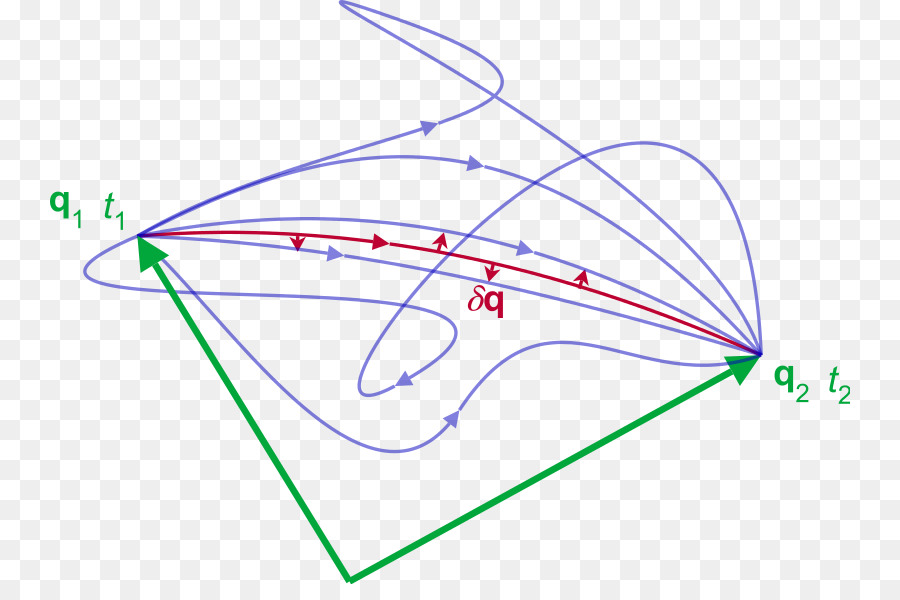
Figure 1
In the figure 1 above, the optimal path is represented in red and the variation of a neighboring path from optimal is indicated as δq.
Accordingly, to find the extremum, we set the variation of the Action to 0:
Sq=0 (7.2)
When this is satisfied, using the principle of variational calculus we can show that the following equation called the Euler-Lagrange equation, is satisfied:
ddt∂Lq=∂L∂q (7.3)
Let’s illustrate with a few examples to see how this is used in Physics. Non-technical readers may wish to skip this section although I would strongly advise to at least just read through.
- Example 1: path of a free particle in Euclidean space
In the simple case of a particle, lets define the Lagrangian L, as the difference in the particle’s Kinetic Energy (KE) and Potential Energy (PE):
L KE – PE (7.4)
Let’s see if we can recover Newton’s 2nd law by using the Action principle:
Since the particle has no external forces and it has no potential energy, only kinetic energy, the Lagrangian using (7.4) is given by:
L=12mq2 (7.5)
Taking the partial derivatives needed for the Euler-Lagrange equation 7.3, we get:
ddt∂Lq=mq=∂L∂q=0 (7.6)
Integrating the 2nd part of equation 7.6 with respect to t we get:
ddtmq=C (7.7)
The Euler-Lagrange equation when solved as in (7.7) indicates that the momentum of the particle is constant when not acted upon by an external force – there is no acceleration. Therefore, the path in figure 1 above will be a straight line between q1 and q2 as we already know from Newton’s 2nd law, and common sense.
This seems like a roundabout way to prove something very simple -in fact, Newton’s 2nd law is axiomatically stated directly as equation (7.7)! What then is the advantage of the complicated-looking Action principle here?
- Firstly, it couches the Action of the particle in a way that is conducive to philosophy: The Action principle gives rise to Nature’s action of (seemingly) choosing a specific path amongst infinite possible paths! This is Nature’s reason for doing what it does!
- Secondly, this form makes the equation Lorentz invariant, which means that the form is universally applicable in any reference frame, further generalizing Newton’s equations which are applicable only in Galilean frames. So, we describe an empirical observation in a very general philosophical framework rather than a special case. This is something all scientists and philosophers seek – to unite all phenomena under a single framework. In this, the Action principle succeeds admirably. The Lagrangian formulation makes it relativistic, valid for any speed, even approaches to that of light.
- Thirdly, this view imputes a deterministic Will to the particle – the particle acts in a way that conserves the difference in its Kinetic and Potential energies. Nothing else is stipulated. This is enough to predict its movement when viewed from any reference frame. The particle is not conscious or willing in any way which we can sensibly describe, nor is it free. There is beauty in this viewpoint!
- Finally, the Lagrangian form makes it easily extendable to the case of general relativity as well as quantum field theory, which shows the continuity and development of our knowledge, in that the form is the same, but the constituents become more complex, as our understanding deepens.
- Example 2: Reflection and Refraction of light
We know that light reflects in a mirror – the angles of incidence and reflection are equal. It refracts when traveling from one medium to another and the ratio of the sines of the refraction angle is the same as the ratio of the permittivities of the media (Snell’s law). These are 2 seemingly separate properties. But in fact, these and all such properties of propagation of light in classical physics can be subsumed under a single Action principle if we define the Action thus: Given 2 points x1 and x2, light always travels along a path in such a way as to minimize the time taken between these points. Nature ‘wills’ light to minimize the time it takes, per the Action principle! So instead of seemingly disparate arbitrary laws of reflection and refraction of light we get just one principle of Action. More importantly, we get the ‘will’ of Nature regarding propagation of light, that of minimization of travel time – that is all we need to know to solve any problem involving propagation of light.
- More examples are listed in the Appendix
- Choice of Lagrangian
It may seem as if the choice of the Lagrangian is arbitrary. Such is not the case. However, it is true that the suitability is determined by trial and error, by ensuring that the predictions from Euler-Lagrange equations are verifiable by empirical data.
- Action principle and free will
Figure 1 illustrates admirably the issue of free will and ethics: given two end points in the moral landscape, a start, and an end, which path will a given being take, out of all infinitely possible paths? What determines this path in actuality? Is there a perfect path and if so how to determine that? As can be gathered from the context, my aim is to extend the Action principle to encompass human action with a suitable framing of the Lagrangian.
I would like to point out how apt the language describing the Action principle (such as Action, optimal path, infinitely possible paths, etc.,) is, especially when we are planning to extend the Action principle to ethics. Such language is what we typically use when we ask an ethical question: amongst an infinite possibility of choices, which path will be the action of an agent and what determines that choice? So, at the outset it seems logical to apply something like the Principle of Least Action to analyze ethical actions!
(In the great Purusha Suktam, the hymn of creation of the Vedas, there is a part of a Sanskrit verse: “na nyah pantha vidyate ayanaya”
न (nā): Meaning “not”, अन्यः (anyaḥ): Meaning “other”, पन्था (panthā): Meaning “path” or “road”, अयनाय (ayanāya): Meaning “for the great journey” or “for the ultimate goal” (e.g., liberation, enlightenment), विद्यते (vidyate): Meaning “exists” or “is” – I know of no other path other than this (for liberation).
The concept of the path for proper action is sought! The ‘this’ path referred to is what we are trying to determine in this essay! But once denied, then indeed, there is no other path than this. It is also interesting to see how closely Sanskrit and English resemble the word ‘path’!)
The above also illustrates the way for us to proceed, using variational calculus. Evaluate every possible moral path and assign a number (This is where the term Moral Value is to be rightly used) – This is the (moral) Action number. We then use KS-PLA to determine the optimal moral path through our moral landscape. The difficulty is in assigning a number to a path. How do we do this? Luckily, using the KS-PLA we don’t need to worry about absolute numbers – As long as we formulate the Lagrangian correctly, the optimal path is picked!
The difficulty then is in formulating the moral Kant-Spinoza invariant moral Lagrangian!
- Epistemology
“It is not my purpose here to refute the assertions of those who assert that the natural light of reason can teach nothing of any value concerning the true way of salvation. People who lay no claims to reason for themselves are not able to prove by reason this their assertion; and if they hawk about something superior to reason, it is a mere figment, and far below reason, as their general method of life sufficiently shows. But there is no need to dwell upon such persons.” – de Spinoza, Benedictus.
I pause to consider a really important question – is knowledge itself the result of some Action principle? If so, is there a meta-knowledge by which we affirm knowledge? If so, what is it? (One may ask, what about the meta-meta-knowledge? Clearly this leads us down the path of self-emergent bootstrap type methodologies, otherwise we will come up against Aristotle’s unmoved meta!)
Aristotle’s Unmoved Mover By Raphael https://commons.wikimedia.org/w/index.php?curid=14522826
Philosophers have struggled with this question and continue to struggle even now. Look around you and see how people struggle to have confidence in their world view! Rarely are people consistent in all that they do. They are unable to voice a consistent philosophy without reference to some arbitrary religion, revelation, spirituality, cult, party, ‘ism’, etc. Their reference for any epistemology is either unknown, arbitrary, or inconsistent. A consistent comprehensive epistemology of knowledge has been non-existent so far. We define consistency as the property which does not allow contradictions. The only one that meets this criterion is the epistemology of science. However, such an epistemology is considered narrow, applicable only to science. Consistency between different forms of claimed knowledge is not demanded (as if different forms of real knowledge can be inconsistent!) as for instance, between science and religion.
This question has forced philosophers to adhere to various schools of thought that have come down the ages: The Stoics, Idealists, Rationalists, Empiricists, Logical Positivists, Communists, etc., and of course, religions.
Just as Gödel asked questions of even the simplest kinds of arithmetic knowledge, the questions to ask of any system of knowledge are:
- Is the domain of such knowledge complete?
Meaning that is there any other form or system of knowledge other than this? The ideal system of knowledge must be complete, that is, all encompassing. Why should we demand this? For 2 reasons: 1) This is how it has been thus far, and 2) This is aesthetically pleasing. Fragmented or disconnected systems of knowledge inherently seem ‘ugly’. Both these assumptions involve an epistemic stance: Knowledge of the Universe is Unitary, and the Universe is understandable.
- Is such knowledge consistent?
If one accepts David Hilbert’s dictum that “(mathematical) existence is merely freedom from contradiction”, then an inconsistent structure would not exist mathematically, let alone physically. This is also an epistemic stance – that contradictions are not allowed. In which case our knowledge must necessarily be expressed in mathematics. (Does this mean that pushing this to the extreme, our Being becomes a tautology of noncontradiction? Poincare investigated this. However, it is the understanding that is important, especially if our mathematical structure is isomorphic to the Universe.)
Is any branch of knowledge inconsistent with any other branch?
An example is a scientist, who applies objective scientific knowledge to investigate the Universe and Nature but chooses to believe in a religion and its corresponding God, Book, and Dogma. A telling example is the great Newton himself. Since the one (religion) contradicts the other (science) his total knowledge was inconsistent. (Let us not waste time and debate whether science contradicts religion – Spinoza, Voltaire, and numerous others have laid this topic to rest), for example, Christianity: From divinity, to miracles, to Genesis, all contradicts common sense and science. This is no different from any other religion. Leibnitz was another such scientist who espoused contradictory systems of knowledge.
At the other extreme, the example of Einstein is more to my liking – He did not hold anything as knowledge other than that of a verifiable experiencer. When asked about things like rebirth and spirituality he professed ignorance and a lack of qualification to speak authoritatively on such subjects where he had no objective experience. The closest he got to (religion) was the philosophy of Spinoza which to me is just an aesthetic description of science. I see very few contradictions in Einstein, in terms of overall consistency. His early belief in socialism can be easily dismissed as naivety. Other such very good examples are Hawking, Dirac, Schrodinger, Chandrashekar, Sagan, etc., all great scientists!
As an aside, it will be curious to examine if most scientists are atheist since theism is not verifiable and scientists use verifiability to do science.
Below is a table that was published in an article from the magazine Nature, with the title: “Leading scientists still reject God”.
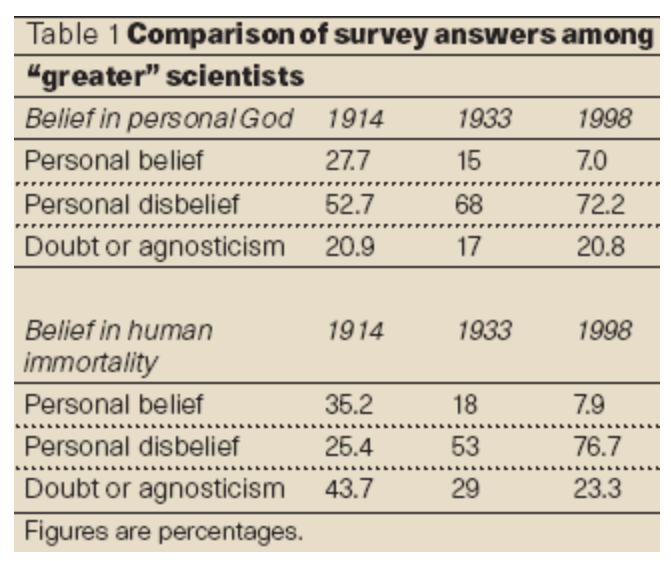
The majority scientists’ view leans towards rejecting a personalized God and towards doubt and agnosticism. If you compare this with non-scientists, A 2019 survey by the National Opinion Research Center reports that 77.5% of U.S. adults believe in a personal god. Clearly, scientists in general tend to be very much more self-consistent than the general population. It is quite likely that the epistemology of science dominates the scientists’ world view, not just their work.
- Is Knowledge absolute or relative?
In other words, how do we know that knowledge is infallible?
Any knowledge is about something in the knowable universe. The knowledge describes that something and makes predictions that we can falsify with observations. If you take the case of metaphysics (for example, the soul or God or karma theory involving rebirth) whose references are not sensible, how can anything sensibly be said about which we have no idea and of which no two people can even agree on the definition? Einstein’s definition of God is completely different from that of the Catholics, which is different from that of the protestants, which is different from that of Muslims, which is different from that of Jews, etc. So, can you quote Einstein on God without understanding his definition of God? Einstein himself was not consistent about his usage. In some instances, he used the term God as a metaphor to convey the universal Will manifested in its Laws. In others he uses the term God as an aesthetic object of beauty encompassing all of creation worthy of veneration, which is perhaps how Spinoza regarded the term God. In no case did he mean something that was even remotely anthropomorphic. However, all people who triumphantly seize Einstein’s quotes to buttress their religion, understand God in the Anthropomorphic sense.
The only way that knowledge can be made to be infallible is if nature is understandable and its laws are fixed such that we can observe nature and model it. The completeness and accuracy of our model serves as a measure of our knowledge and the reference is objective reality or nature which means that the nature and arbitration of our knowledge is derived from nature itself. It must be self-emergent.
Except for the domain of science, there is no consensus on infallibility or completeness of knowledge. The claims of most religions would be nonsense or untrue if based on objective knowledge. For example, creation of the world in 7 days, the concept of God resting after, the immaculate conception, Heaven, Hell, miracles, superiority of humans to animals etc. Other such claims are rebirth, extra sensory perception, existence of the soul, its immortality, and most if not all metaphysical ideas.
The only way for certainty is some unifying principle that must be negated to deny even the most basic propositions of reality. Such a principle is the principle of self-consistency (SCP). Let’s look at its properties:
- All referents of this knowledge system are sensible.
- Models can make verifiable and falsifiable predictions.
- It is not restricted to the privileged few however defined, but accessible to all who make the effort to learn and understand. In that sense it is peer reviewed. Consensus builds confidence on the model. No need for priests and a privileged church!
- The principle is self-evident and quite simple in essence. There is no dogma. This is how a child learns about the objective world.
- There is nothing that says that this principle has a limited domain, say only science. Any edifice can only stand if there are no contradictions in any part of it.
- The model can be continuously modified and updated as needed and this is the way that our knowledge increases.
To put our advanced view in perspective, let’s look at some historic examples of what some great people have said on this topic of how to acquire infallible knowledge.
- Renee Descartes: doubt and self-evident affirmation
Consider the great Renee Descartes who asserted in his 1st rule: “Accept nothing that is not self-evident” – but the crux lies in the ‘self-evident’ – how do we establish that? His answer: “Intuition, wherein, the idea is clear and distinct in one’s mind, leaving no room for doubt”. The obvious fallacy in his assertion is that someone’s intuition can be wrong, can be very different from another’s and the whole thing becomes subjective or arbitrary as there is no connection to any reference (objective reality). One can have a clear and distinct idea of something and still not know anything about it or be wrong about it. Clearly, this is not an infallible method for building knowledge since intuition is not infallible – to see this compare your intuition with that of anyone else on any topic. This system fails all 3 of our requirements. Imagine how much trouble Descartes could have saved himself and us, if he had asked himself our questions?
- A-priori knowledge by pure Reason
In this school of thought knowledge is built-in, a-priori (prior to experience) into the mind, independent of objective reality. Most religions also belong to this school of thought. Does this system satisfy any of our 3 questions? No, since it is not clear as to what this knowledge is. First, can this knowledge do anything useful? make any predictions that can be verified or falsified? The answer is a resounding no! Kant specifically puts this knowledge out of the realm of objective knowledge and relegates religion, aesthetics, morality, etc., to that realm. Since it is not knowledge by any sensible definition, I reject it outright as literally nonsense just as A.J.Ayer did.
- A-priori knowledge by intuition
This theory postulates that knowledge is obtained outside of the physical realm by an intuition which is a process outside of objective reality. Perhaps this mode of belief came about due to flashes of intuition that creators often had seemingly without reasoning, an example being the ring structure of benzene, Newton’s law of gravitation, Einstein’s laws of special relativity, etc. This theory can only be true if the process of intuition were to be shown to be outside of experience as well as the given structure of the brain as influenced by genetics. As far as I know there is no viable theory explaining intuition. The explanation I favor is that intuition can come about in at least 2 different ways: 1) Powerful capability (resulting from evolution) of the brain to look for patterns constantly amidst all kinds of data and 2) Some aspect of random thinking, something akin to optimization algorithms by ‘random walk’. In any case, there must be an objective biological evolutionary explanation for intuition. Nothing is being taken away from the usefulness of intuition, nor denying its existence, just its transcendental origin. However, intuition is not knowledge unless verified objectively.
- A-priori that is admissible in our system
Now there is an a-priori (which however is not transcendental) but Kant never recognized it and consequently failed to develop it. There is an a-priori in humans that can be identified with the algorithms in the human brain resulting from evolution, as for example: capacity for language, identifying cause-effect relationships (a thing that Hume first identified and struggled with), capacity to reason, capacity for moral action, capacity to evaluate aspects of beauty for selection of suitable mate, etc. These can be thought of as classes of relatively fixed algorithms (whose operative ‘weights’ are determined by learning during the lifetime of the being), differently for each person based on their experience, affecting their capacity in this regard, some having a greater capacity and others less, but all have this capacity more or less. In this viewpoint of the a-priori (and it is indeed a-priori to experience) it may be regarded as knowledge but nothing that is out of the objective physical, it is not transcendental. I will allow such an a-priori, which is nothing but genetics.
- Knowledge (Within Gödel’s limit)
I define Knowledge as information of the universe that satisfies all our 3 questions posed above – tending towards being complete, consistent, verifiable. The observable Universe is the infallible reference and source. The only known system of knowledge that satisfies the above is the Epistemology of Science.
More formally, knowledge is a hierarchical system of concepts that are a non-contradictory identification of reality – such knowledge is verifiable by anyone in any frame of reference, who takes such trouble.
The acknowledgement that mathematical physics that we use to describe the universe works so well especially because of the idea of Structural Realism, that this scientific description of the world is real and believable either in the epistemological or ontological sense is a central assumption in this essay. An extreme example in this direction is the idea that the Universe is mathematical (Tegmark 2007): “Whereas the customary terminology in physics textbooks is that the external reality is described by mathematics, the Mathematical Universe Hypothesis (MUH) states that it is mathematics (more specifically, a mathematical structure). This corresponds to the “ontic” version of universal structural realism in the philosophical terminology. If a future physics textbook contains the Theory of Everything (TOE), then its equations are the complete description of the mathematical structure that is the external physical reality. We write ‘is’ rather than ‘corresponds to’ here, because if two structures are isomorphic, then there is no meaningful sense in which they are not one and the same”
Note that Gödel has shown that Completeness and Consistency to be not possible simultaneously (in a narrow specific branch of Arithmetic). So perhaps we seek our knowledge (completeness and consistency) to Gödel’s limit! While Godel’s incompleteness theorems are hard to ignore, my speculation is that it is impossible to give a complete and consistent external description of any system while being inside of it – Tegmark differentiates this as the frog view of the universe (being inside the well) vs the bird view looking at the frog-in-the-well from way above. One way to explain this inadequacy is the realization that we always need a model to understand the universe. The model may involve some structural assumptions that add some uncertainty. It means that our description may not be complete and consistent at the same time. But we have a long way to go before we hit this asymptotic limit. This is explained quantitatively in our discussion of the K-factor for knowledge, further below.
Knowledge – Biology holds the key
Since early times to now, humans have given fanciful explanations for many aspects of knowledge. For example, the entire field of metaphysics consists of terms that are hard even to define, let alone explain. Terms such as Substance, God, Eternity, Infinity, Transcendental, Spiritual, Material, etc. Philosophers have tended to overlook the fact that the brain and behavior of complex life organisms have evolved over long periods of time and that every aspect of an organism can be attributed to a long period of evolution. Therefore, instead of looking for explanations in biology, fanciful speculations have been put forth as knowledge. Take the works of most philosophers: Plato proposed the transcendental theory of forms to explain how we form concepts. If he had examined it through Biology he would have understood it as we understand it now – abstracting the essentials over a wide range of possibilities. Most if not all of these tended to create the body-mind dichotomy with devastating effects upon civilization. Instead if they had focussed on studying the human body and the nervous system, many things would have been clearer earlier – spirituality, fear, jealousy, anger, hope, purpose, reason, sexual attraction, desire to procreate, desire to teach, aberrations amongst these, etc. The study of these using life forms would have given the correct knowledge. For some 2000 years philosophers speculated instead of experimented. They ignored the most powerful force of animal life – Sex. Biology holds the key to philosophy and for just about anything else regarding animal life.
In this regard consider the proposal by Grice. M (Grice 2023) that
“Arithmetic has a biological origin: Many examples of adaptive behavior such as spatial navigation suggest that organisms can perform arithmetic-like operations on represented magnitudes. If so, these operations—nonsymbolic precursors of addition and multiplication—might be optimal due to evolution and thus identifiable according to an appropriate criterion.” Their results show that numbers and algebraic structure emerge from purely qualitative conditions, and as a construction of arithmetic, provide a rigorous explanation for why addition and multiplication are its fundamental operations. They argue that these conditions are preverbal psychological intuitions or principles of perceptual organization that are biologically based and shape how humans and nonhumans alike perceive the world. A key concept underpinning this is structure and ……. @TODO
- Knowledge – Lagrangian
So, coming back to my previous question, can the principle of science itself arise from an Action principle? If so, what is the Action?
I say an emphatic yes! (Anything in nature can be framed as an Action principle), and I will formulate the Lagrangian as:
L = proliferation of models + Error in predictions (8.1)
Science works by postulating models and verifying predictions of these models with experiments and observations. The observations either validate or falsify the model. Also, of importance is to minimize disparate models to describe reality, piecemeal – rather, have one comprehensive model to describe all fundamental reality. The 1st term serves to implement Occam’s razor. The reductionist philosophy of science demands that reality be described with as few axioms and ‘tuning constants’ as possible. The reductionist unification aspect is a hallmark of scientific thinking. The fact that the universe seems to make this possible is significant and something that plays an integral role in my proposal. An example is the Standard model of physics which purports to explain all of physics (but so far has failed to include gravitation which has its own model, the theory of general Relativity). So, our Action principle stated above for science will drive us to ultimately have a single model explaining all observed phenomena. So note that the meta-principle of knowledge and knowledge work using the same Action!
As Carl Sagan famously observed, beings from a different civilization on a distant alien star system will still have the same laws of science as we do even if their notation and reference frame may be different from ours. This invariance is built into our description of the Action principle describing Epistemology of Science.
In a way, the Action principle becomes the simplest Axiom of the underlying system from which the rules of the entire system can be derived. It imputes a dispassionate teleology to the universe.
Quantifying knowledge
(Fanelli 2019) gives an equation to evaluate the (normalized) degree of knowledge based on Shannon’s mutual information and is:
K(Y;X,𝝉) =HY-HY|X, HY11+nXH(X)-logp()nYH(Y) (8.2)
Where,
Y constitutes the explanandum (latin for what is to be explained),
X and τ constitutes the explanans (latin for what does the explaining) where,
X is the input (data from our observation) and τ constitutes the theory,
H(Y) is the entropy (or measure of uncertainty) of the explanandum, H(X) is the entropy of the input and H(T=τ) is the entropy of the theory of fixed number of bits, say n.
H(Y|X) is the conditional entropy of Y given X (and a theory, τ). So if our theory is perfect and our inputs are perfect we have perfect knowledge as Y is fully predictable given X (and a theory, τ), H(Y|X) → 0 and so K → 1. Therefore K tends towards 1 for perfect knowledge and for the simplest theory that is adequate.
On the other hand, if the theory τ and inputs X are inadequate to determine Y, then H(Y|X) is similar to H(Y) and maybe even greater and so K tends to 0 or even negative.
Equation 8.2 accounts for the Occam’s razor by explicitly accounting for the theory τ in the 2nd term on the right hand side. I chose to ignore this term for simplicity or alternately to make it implicit as part of X. Since a theory and inputs are always necessary, K can approach but never equal 1 except asymptotically. Perhaps this is the root cause of the Godel completeness-consistency issue!
So for complete knowledge, we could also formulate our Action and PLA as follows:
SY=[KY;X, -1] dt=0 (8.3)
The above optimization would converge us to theories and inputs that get better at reducing our uncertainty. The metricization of a moral theory is carried out in more detail in the My synthesis section below.
Spiritual Knowledge
At this point I will discuss if the human mind is inherently limited by its rationality. Kant, who was enormously influenced by Hume, claimed that the human mind could never know ‘ultimate reality’. He claimed that the human mind by its nature could only understand reality through an ‘a-priori’ medium of cause-effect which was a facet of the observer and that the original reality was ever unknowable. This sort of a statement is often made by people who claim that Human Reason is limited to objective knowledge, and in principle, cannot go beyond – meaning, that there is some ‘higher’, supra-rational knowledge that they are somehow able to tap into. Many philosophers and most theosophists (for example St. Augustin, Plato, Kant, Aurobindo) profess such views. There is a variation on this viewpoint: That the world is experienced subjectively, that one can never truly know the thing-in-itself of nature, only our subjective experience of it (Kant, Schopenhauer, Berkely). I give below my reasons as to why this is not knowledge at all.
There does not exist a standard definition of spirituality. Per Wikipedia, Spirituality can be defined generally as an individual’s search for ultimate or sacred meaning and purpose in life. Additionally, it can mean to seek out or search for personal growth, religious experience, belief in a supernatural realm or afterlife, or to make sense of one’s own “inner dimension”.
Compare this with the arduous rigor, observation, experimentation, and mathematical analysis that is required to acquire the simplest of objective knowledge. Clearly, Spiritual knowledge can be claimed by anyone without possibility of refutation. Seemingly, it gives anyone, even people with the most meager intelligence and learning, an easy path and claim to ‘knowledge’. Therein lies its appeal and popularity.
- Spiritual knowledge is claimed to be superior
Spiritual knowledge is often claimed to be ‘superior’ to ordinary knowledge of the real world. However, this claim fails this simple test: Objective knowledge is not a subset of this ‘superior’ spiritual knowledge, which means that this knowledge is not complete and not consistent – It fails our elementary test.
- Everyone can have Spiritual experience, it is not magic
If I can examine what is common amongst published experiences of various ‘spiritualists’ and compare it with my own, I can abstract the following:
- ‘Spiritual’ states are usually triggered by aesthetic, religious, or meditative contemplation or by awe inspiring events.
- When in a ‘spiritual state’, there is a feeling of being elevated, of height, soaring through space, the body is not felt, the skin hair stands on end (goosebumps), there is a brightness in the head, tears in the eyes, etc. I have heard descriptions of ‘currents’ or sensations along the spine, but I have not experienced this. I have experienced tingling of the scalp.
- In my own case, aesthetic contemplation is the trigger, such as listening to Mozart’s 39th or watching a Ballet performance, or watching a flight of white birds across black clouds during a flaming sunset, purple flowers against an azure sky, Swiss mountains, lakes and countryside, etc. There is no knowledge, it just seems like a special emotional state.
- Triggers vary. For example, the great Indian mystic, Sri Ramakrishna Paramahamsa frequently went into a trance listening to devotional songs, other mystic saints went into a trance on contemplation of their God.
- People are not able to solve real world problems during this state. It seems to be an experience where thinking is not involved but rather an intense sensation of pure being is felt.
I speculate that an fMRI scan can throw light on what is really happening. My conjecture is that triggers like those mentioned above excite cognitive clusters into resonance due to finite cross-correlation and this is what is felt as an ‘elevated spiritual’ experience. Since different individuals have different cognitive wiring, my theory is plausible in that it admits different triggers and different resonances. In this sense, the response is subtle and can be ‘damped out’ at will by not concentrating on the triggers. The response is also a happy side-effect of the complex cognitive wiring that has resulted from genetics and experience, to accomplish specific cognitive functions. This is plausible since a network of cognitive neurons is an electric one having complex modes due to the feedforward and feedback. If an excitation with similar frequencies excites this network, it is possible to excite modal oscillations. Clearly these oscillations are a ‘happy’ result and not the original ‘intention’ of the network. If this theory is true, then it is probable that the higher animals too experience ‘spirituality’ if they have a complex enough brain structure and excited suitably by correlative audio-visual triggers.
There are states that have been mistaken for spiritual experiences but seem quite different from the set described above such as ritualistic repeating events such as devotional dances, for example the whirling dervishes. I speculate that these are similar to epileptic seizures.
- Induction
Incidentally, there is a huge misunderstanding about the role that induction plays in knowledge. In simplest terms it is commonly held by some philosophers (especially Hume and Kant, and their followers) that no empirical statement can be held to be true logically since empirical statements use the induction principle and there is no guarantee that the induction principle will continue to hold indefinitely into the future. There are monstrous misconceptions here. If you look at the operation of all the devices made by humans and calculate the incidence of failure of laws formulated based on induction, the answer is none. Just the data from the Large Hadron Collider involving data from trillions of particles will put the failure to 0. Secondly, the very fact that humans have a rational brain, points to an unbroken chain of cause effect – if cause-effect were random, evolution of the rational brain would not have been possible. Thirdly, to wait for a principle to break tomorrow when it has operated for billions of years without fail is more than absurd. Fourthly, astrophysical phenomena such as CMB (Cosmic Microwave Background Noise) have proven that principles we know to be true now have been true ever since the creation of the universe some 13.6 billion years ago! And lastly, to seek certainty where there is none is absurd. So, I regard this as a non-issue. Where there is no possibility of certainty, it is foolish to look for one, the best one can do is work with probabilities. If one has doubts about the induction principle one should never fly in an airplane, put money in a bank, drive a car, or go to a hospital, because the laws of physics may change at any moment! Incidentally, there is a finite but vanishingly small chance that money put in a bank can evaporate due to quantum tunneling’. No doubter of induction will ever remotely worry about this probability!
- Thing-in-itself (Ding-an-sich) of Kant
To quote from Wikipedia: In his doctrine of transcendental idealism, Kant argued the sum of all objects, the empirical world, is a complex of appearances whose existence and connection occur only in our representations.[2] Kant introduces the thing-in-itself as follows:
And we indeed, rightly considering objects of sense as mere appearances, confess thereby that they are based upon a thing in itself, though we know not this thing as it is in itself, but only know its appearances, viz., the way in which our senses are affected by this unknown something.
— Prolegomena, § 32
Subjective idealism followed and made its mark in Europe in the 18th-century writings of George Berkeley, who argued that the idea of mind-independent reality is incoherent, concluding that the world consists of the minds of humans and of God.
Knowledge is nothing but information about something. All information ultimately is propositions, as you dig down into the finest detail, stating whether something is either true or false. Necessarily there must be transducers that generate information based on sensing of the real world. Our eyes for example are nothing but optical transducers that generate electrical signals based on the frequency and intensity of light which is electromagnetic in nature. When I see light from a yellow-green tennis ball I know that the wavelength is about 450nm. I don’t need to know anything further than that. There is a 1-1 map between the signal being sensed and the transducer’s response. In the case of my eye, the color and intensity of perceived light corresponds to its frequency and intensity. I don’t need to know the thing-in-itself of light whatever that may be. (I don’t wish to examine this deeper, such as what happens if blue and green light combine to give yellow light. The same explanation can be used in terms of averaging of sensor outputs etc.).
A question may be asked: What if different people sense this color differently? Well, what if? First, if we are constructed the same way, the response should also be the same for the same stimulus. Furthermore, if there were to be a subtle variation in color as for example instead of pure red as RGB(255,0,0) we gave someone something very close to red, say RGB(255,1,1), they would never be able to tell the 0.8% addition of Blue and Green to Red whereas a scientific measurement could. Many times my wife will correct me when I say red instead of Orange, Magenta instead of purple etc. Does that mean anything? It just means that I am not knowledgeable about my colors and even if I were to be, my precision for differentiation would be crude. But if I build an instrument with good precision and it can definitely categorize color, then I agree with the instrument, not my subjective feel.
Let’s say I am blind, and a new surgical procedure can now enable me to feel light as tingling sensation on my fingers. Clearly this is even farther from the thing-in-itself whatever that is. Does this make any difference as long as I have a new 1-1 map of my new finger sensations and the light frequency and intensity? Absolutely not. A bat can see in the dark what I can see in the day and we see the same thing with different transducers. A simple way is to claim that as long as there is an isomorphism between 2 domains, they are equivalent so that if according to Kant the unknown thing-in-itself always maps to an appearance then the thing-in-itself is equivalent to the appearance, end of debate.
So, while Kant and Berkely and even Schopenhauer are correct in that we will never know the thing-in-itself, per their definition no one can, and it doesn’t make any difference to anything. To make a big philosophical deal about something that no one can even define is a waste of time.
- Pain, Entropy, and Optimization engines
- Will of Life as an optimization Engine – Why Pain is essential for Evolution of Movement and thus Complex Life
From Ref [2], page 66, 4.11: In evolutionary terms, pain has evolved from nociception as an aversive sensory mechanism that warns of harmful experiences. Pain has three main functions: First, it allows animals and humans to avoid dangerous situations, as painful experiences usually prompt an immediate impulse to withdraw and escape from situations that cause harm, usually in the form of tissue damage. Secondly, as pain is associated closely with the environmental context in which it occurred, its experience can help to prevent repeated damage. Pain-causing experiences will be avoided through learning when a similar environment is encountered again. Thirdly, pain promotes the healing of injuries, as affected body parts are not used in normal activities, as far as possible.
Any autonomous system needs Learning to predict its environment to regulate its position and actions in an unknown or varying environment. It is easy to see that if an environment is fixed (conditions are static and there is no need for any movement) then there is no need for feedback. A system can be tuned and left alone to operate without intervention, external or internal. Feedback is only needed when there is movement and when there is a dynamic unknown environment. Trees are static and therefore only need limited feedback.
Now consider animals. They need to move to find food and shelter and to mate. If they do not have feedback, they will never be able to regulate themselves safely. Animals have a central nervous system that facilitates learning that can predict its environment and reduce the animal’s uncertainty, its entropy.
From Hirsh, J. B., Mar, R. A., & Peterson, J. B. (2012, January 16). Psychological Entropy: A Framework for Understanding Uncertainty-Related Anxiety. Psychological Review. Advance online publication. doi: 10.1037/a0026767
Entropy, a concept derived from thermodynamics and information theory, describes the amount of uncertainty and disorder within a system. Self-organizing systems engage in a continual dialogue with the environment and must adapt themselves to changing circumstances to keep internal entropy at a manageable level. We propose the entropy model of uncertainty (EMU), an integrative theoretical framework that applies the idea of entropy to the human information system to understand uncertainty related anxiety. Four major tenets of EMU are proposed: (a) Uncertainty poses a critical adaptive challenge for any organism, so individuals are motivated to keep it at a manageable level; (b) uncertainty emerges as a function of the conflict between competing perceptual and behavioral affordances; (c) adopting clear goals and belief structures helps to constrain the experience of uncertainty by reducing the spread of competing affordances; and (d) uncertainty is experienced subjectively as anxiety and is associated with activity in the anterior cingulate cortex and with heightened noradrenaline release. By placing the discussion of uncertainty management, a fundamental biological necessity, within the framework of information theory and self-organizing systems, our model helps to situate key psychological processes within a broader physical, conceptual, and evolutionary context
As trees do not move and have no central nervous system and animals do need to move and do have a nervous system it is plausible to argue that pain is nothing but feedback needed by living beings that need to move. Pain is a feedback signal that tells a (moving) organism that it lacks an essential or it is in danger and impels it to move (act) in a certain direction to minimize this pain. Clearly there are some optimization algorithms at work in this minimization.
It is quite easy to see that without pain we would destroy ourselves and ‘higher’ life could never have evolved. We would burn ourselves, step off cliffs, fall off trees, never go hungry and hence die, etc. There is no motivating force to act. Pain (and pleasure) are the motive force for survival and reproduction. Nature has spontaneously evolved life and the only way for it to do so was to evolve pain. Pain is central to life. This is an important conclusion that I will use to support my argument as to why morality involves dealing with pain in a central way.
- Do Animals Feel Pain?
There are barbarians who seize this dog, who so prodigiously surpasses man in friendship, and nail him down to a table, and dissect him alive to show you the mezaraic veins… Answer me, Machinist, has Nature really arranged all the springs of feeling in this animal to the end that he might not feel? Has he nerves that he may be incapable of suffering?
The above was a sarcastic rejoinder by Voltaire to Descartes (The Machinist reference above) to refute the latter’s claim that animals do not feel pain.
Voltaire continues in the same vein:
“People must have renounced, it seems to me, all natural intelligence to dare to advance that animals are but animated machines…. It appears to me, besides, that such people can never have observed with attention the character of animals, not to have distinguished among them the different voices of need, of suffering, of joy, of pain, of love, of anger, and of all their affections. It would be very strange that they should express so well what they could not feel.”
From Ref [2] page 72 4.29: In conclusion, it is extremely difficult to determine exactly the subjective experiences of animals in relation to pain and suffering. However, the evolutionary continuum that is obvious from physiological, neurological and behavioral similarities between humans, primates and other animals allows us to make meaningful approximations. While we need to ensure that applying terms such as pain and suffering to animals does not lead to undue anthropomorphism, their vagueness does not render them inapplicable or useless. It is also important to consider the fact that animals may experience negative welfare from circumstances that would not be sources of harm for humans.
From Ref [2] page 70 4.23: ..suffering is ‘a negative emotional state which derives from adverse physical, physiological and psychological circumstances, in accordance with the cognitive capacity of the species and of the individual being, and its life’s experience.’
Pain drives the basic will to live – the primal purpose of life.
Without pain, complex animal life could not have evolved. So, pain is not an evil from that point of view. An animal that aims to live ‘well’ acts in such a way to minimize this pain. This is an optimization problem and requires an optimization algorithm that evolution has ‘forced’ upon complex animal life.
With a little thought we can satisfactorily conclude that the will of any given organism is a learning system with an optimization engine. Its aim is to minimize pain by acting within its capability in order to reach goals set a-priori by genetics.
The similarity between the optimization (minimization) of the Action principle and that just mentioned here, is striking.
Another point of view is to relate pain of any kind to its entropy (disorder or uncertainty felt by the being in relation to the environment). The optimization engine is then the principle of least action that picks that path with the least entropy. It is in this way that we can relate Entropy to living beings which have a learning system. Clearly the learning system is an optimization engine.
- Pleasure vs Pain
It is tempting to regard pleasure and pain as being at opposite ends of the same axis. Clearly, alleviating pain can be considered pleasureful. However, even if pleasure cannot be absolutely defined (without reference to pain) we can still ignore pleasure to the 1st approximation in our ethics. Some honest reflection will reveal that our lives and actions are mostly directed at trying to reduce pain (eat food to satisfy pain of hunger, wear clothes to reduce pain of heat/cold), struggle to find a partner (to satisfy pain of sexual deprivation), have children (to satisfy pain built-in by evolution to have progeny, caregivers in old age) etc.
Another way to justify consideration of only pain and not pleasure is as follows: Since pleasure is not infinite and pleasure is just pain that crosses the 0 on the axis and becomes negative such that we can talk of negative pain as pleasure. In such cases, we can just add an offset C to the pleasure/pain quantity algebraically such that both quantities have the same sign. We can then freely use only pain (entropy) in our Action calculations.
- Action Principle and Free Will
I have already introduced the Action principle in a prior chapter. To keep matters tightly focused on my main aim which is to see how the Action Principle is to be applied to ethics, I shall give my working definitions for living and non-living beings and degrees of consciousness. Here is an Arxiv paper, Survey of Consciousness Theory from Computational Perspective as of 2023. My own summary below will pain a pedant but will do for my purposes:
- Inanimate (non-living) things
Inanimate beings are objects that do not have life – they cannot feed, reproduce. They do not have state variables that are hidden from an observer that actively manage their entropy and minimize it. Action principles of physics can be applied to describe their motion. Active ingredients of motion actuation are gradients of potential energy such as a gravitational field or an electromagnetic field, etc. There is no self-willed actuation, there is no choice of action, it is determined by the Action principle governing matter. A poetical metaphor is to say that they follow God’s Will, the poetical God being a Spinozist or Einsteinian God. Examples are rocks, chemicals, metals, composite objects made up of combinations of such metals and chemicals, etc. A tennis ball does not move on its own volition but needs to be hit by a tennis racket. If the force of the tennis racket is known, the motion of the tennis ball is completely determined. The Action principle of physics determines its motion completely. A dry leaf gets blown by the wind. Its state variables are position and momentum. Both are determined by the force of the wind and the leaf’s constitution (material and shape) using the Action principle of Physics. When two spinning black holes gravitationally merged some 10 billion years ago, in spite of the immensity of the physics the phenomenon can still be modeled and predicted using the Action principle of physics.
- Animated (Living) things and the Soul
Aristotle was perhaps the first to recognize that life, self-willed movement, and possession of a ‘soul’ were one and the same. (Note the title of his work, De Anima which translates to “On the soul”. To summarize Aristotle:
Animation and the Soul:
The Soul as Life-Force: Unlike Plato, who saw the soul as separate from the body, Aristotle argued the soul is the form that gives life to the body. It’s the essence that makes something a living being, not just a lump of matter. Think of it like the software that makes a computer function.
Levels of Souls: Different living things have different levels of soul. Plants have the most basic level, allowing them to nourish themselves and reproduce. Animals have a higher level, enabling them to sense and move. Humans have the highest level, possessing all the above plus the power of reason.
Importance of the Soul:
Function Determines Soul: The soul’s nature is revealed through its functions. A plant’s soul allows it to perform plant-like functions, and a human soul allows for reason and thought.
Soul is the Entelechy: Aristotle uses the concept of entelechy to describe the soul. It’s the complete potential or realization of what something is. The soul is what makes an organism a functioning, living thing.)
These (life forms) are unique to the universe so far as we know, and result from long periods of evolution. They exhibit ‘voluntary’ motion (exhibit a will), feed (consume energy), reproduce, feel pain to various degrees, etc. Examples are members of the plant kingdom and members of the animal kingdom (I will reserve discussion on robots till later). What differentiates them from inanimate objects are state variables that are hidden or difficult to characterize and observe due to sheer complexity, active management of their (uncertainty in informational representation of the world) entropy to minimize it by dissipating entropy they produce to the surroundings – they are manifestations where entropy is locally minimized. Example of hidden or difficult to observe state variables in humans: A human being deep in thought (the thought represents hidden variables). Animated beings have resulted ultimately from inanimate inorganic matter due to a process we call Evolution first put forth by Charles Darwin. The process of Evolution itself follows its own Action Principle that can be described in terms of thermodynamics that we won’t go into here (see this paper as an example).
Because of the hidden and complex nature of these state variables, I name these collectively as ‘soul’. Thus, the soul wills its owner to act. In our terminology, Action is what causes objects to act. So, I assert in a very Spinozist manner, that the soul is nothing but the Action of a self-animated object which is indistinguishable from its will. This is not different from Aristotle’s definition.
- No free will
I want to make the case that free will does not exist. I maintain that a will is seemingly free due to ignorance of the universe. The degree of freedom then correlates to the degree that a will seems to be free. Obviously, we are only talking about free will as pertaining to agents that can act. To get clarity it is helpful to look at limiting cases:
- Complete Ignorance
If you know nothing, then you are completely ‘ignorant’ and your actions are based on random chance or some pre-set algorithm that acts independent of your awareness, sub-consciously as it were. To illustrate this, let’s say that I am put in an unknown dark room with no sound or smell, and I am supposed to locate a writing table and pick up a pen on it. My movements to locate the table will be completely random! I may have an algorithm to search for it but due to lack of feedback I will not be certain of my movements. The paths of all people undergoing this test will be almost completely random and dissimilar to each other displaying the random nature of their free will. (The ensemble of movements will appear random. However, any one individual’s movement will still not be completely random. If we knew enough of the individual, we could predict the motion of the individual in principle).
Another example is that of a person who has lost his way and comes to a fork. He has 2 possibilities (not counting turning back) – but since he is lost, he will necessarily choose at random. Different people will choose differently based on their biases modulating random chance. If we have a large enough sample of such people, we will get 50% probability for each of the possible choices, like a coin toss.
- Complete Knowledge
If you know everything about your universe, then your knowledge is complete, and your actions are determined. You are God! To illustrate this, let’s say that I am put in a known room that is brightly lit and I am supposed to locate a writing table and pick up a pen on it. My movements to locate the table will almost be predictable! I will move with a precision that is dependent on my motor/sensory system straight to the table and pick up the pen. All people undergoing this test will act in a narrowly restricted band of paths.
(Looking at our example of a person who comes to a 2-way junction and is not lost, he will pick the correct road since he has full knowledge of how to get to his destination. To guess now is perfectly stupid! So free will here equates to stupidity!)
- Why any variations in the above example?
As already mentioned, the variation comes about because of the difference in natures: By my essential nature (genetics/habit) when I wish to walk to a target visible to me with a well-marked path to it, I may walk along the middle of such a path. Someone else may walk along the left edge, someone else along the right edge, etc. However, many of us will walk along the path, constrained by the path. The path taken by this set of people (let us call them set A) is constrained by the marked path.
Another set of people (we will label them set B) will ignore the marked path and cut across to find the shortest path (we have all seen such people in parks who ignore the marked paths and cut across the lawns, spoiling it). They will desist only on pain of punishment. The nature of this set of people is markedly different from the set that adheres to the marked path.
So, the freedom of choice in choosing the path comes down to 2: those that belong to set A will choose the marked path and those that belong to set B will short cut across to the object. With a little bit of study of these 2 sets of people we would be able to predict which set any random person will belong to, with high certainty.
In the above example, if I replace the room with my Universe, the purpose of picking up the pen with the purpose as determined by my Action, then, I can conclude that any free will that I have, is solely due to my ignorance of my Universe.
When there is no perfect knowledge, who or what is making the (uncertain) decision inside of us? My guess is: Noise in algorithms, a-priori subconscious biases or other cultural defaults, experience from similar situations in the past, imperfect conclusions based on sensory data, prayer, perceived religious guidance, etc.
In what then does your liberty consist, unless it be in the power that your self has exercised in performing what your will required of absolute necessity?
― Voltaire (Liberty)
I do not believe in free will. Schopenhauer’s words: ‘Man can do what he wants, but he cannot will what he wills,’ accompany me in all situations throughout my life and reconcile me with the actions of others, even if they are rather painful to me. This awareness of the lack of free will keeps me from taking myself and my fellow men too seriously as acting and deciding individuals, and from losing my temper.
― Albert Einstein 1932, My Credo
We can carry this experiment to greater and greater depth of detail: What if it is an emergency? What if no one is watching? Etc. A little thought will convince us that we can use arguments like what we have already used to state that given a certain known scenario, actions will be bound in a very tight window implying that freedom of will doesn’t exist, the action is determinate, an Effect following its Cause – in the limit of perfect understanding it is the Effect following its Cause.
This leads us naturally to talk about Cause and Effect next.
- Cause and Effect
Cause and effect thus constitute the whole nature of matter; its true being is its action.
― Schopenhauer
Causality is an essential concept in epistemology. Simply, the response from any system cannot precede any excitation or in layman terms, an effect is produced by and after a cause (Modern Physics is moving away from statements of Cause-Effect. Rather, it models relations between entities using differential equations. The identification of cause and effect in physics is almost for the sake of convenience of language – which mode of description is almost phased out.)
But what do we generally mean by words like “causality”, and phrases such as “cause and effect”? Usually, we mean that the cause of any event must precede any of its effects. We also mean that if there is a sequence of events in nature that is repeatable, then such patterns are describable by a set of differential equations which institute the restriction laid down by the causality principle stated above. If the equations are simple enough, we might be able to abstract a cause on one side of the equation relating to an effect on the other side of the equation. In the absence of a cause its effect is absent too.
A convenient example is that of Newton’s 2nd Law which states that any change in Momentum (that is, acceleration) can only be caused by an externally applied force. Here, acceleration is the effect and force is the cause and necessarily precedes the effect. They can never be separated.
Cause precedes Effect. The Effect can never be instantaneous meaning in 0 time since the forces required then become infinitely large, which are never so in practice. Also, the effect lags the cause by at least the time it takes light to travel from causal force to the body under consideration. Causality is a primary requirement for any physical theory.
The cause of involuntary motion is some external force. In physics the effective force in most cases is very elegantly described as a gradient of some potential (energy). The simplest example is a particle that is placed on a smooth hill on Earth. Due to the gravitational inverse square law there is a gradient of potential energy along the hill – the higher you go up the hill (away from the center of the Earth) the larger is your potential energy. So, the gradient is along the slope of the hill and pointed up the hill. The principle of least Action (PLA) when applied here results in a force that is the negative of the gradient of the potential energy. This force is the familiar gravitational force pointed down the hill. Here, we can talk about gradients of energy as the external, motivating cause to move. We can impute the principle of least Action as the ‘Will’ causing this movement. Another example is the electromagnetic vector potential, A.
We can also talk of gradients of certain qualities that cause action in animated objects. The simplest example is that an animal wills (moved, caused) to feed itself as it feels the gradient of pain (from satiation to hunger). Similarly, it wills itself to move to get away from a hot object (pain increases as it gets closer to hot object and the -ve gradient points away from the hot object). So, we can talk of movement as always caused by gradients of something. This something is a potential energy field in case of involuntary motion, and pain in the case of voluntary motion.
We can model pain as potential energy (gained as you go up a hill, due to Earth’s gravitational force). It is that abstract manifold on which, the higher we get, the greater is the pain we feel. The gradient of pain is given by the slope at any point and pointed along the slope, upwards. Therefore, the negative of this gradient is the apparent force that actuates the animal to move to reduce the pain. Here we do not model how the pain is built up – Hunger, urge to reproduce, protect the young, kin protection, sleep deprivation, disease, fear of predators, etc… Each of these can be modeled as a separate generator of (entropy) pain. Later on we extend this hill as a moral landscape where the Action is represented as a number given any moral path.
- Intermediate things
What about things like cells in a plant? Bacteria? Are they living? Animated? This is a difficult question since they form part of the necessarily fuzzy border in the continuum between inanimate and animate objects and for the moment, we will ignore them for simplicity.
- Evolution
In the natural world, only living things (and their artifacts) have ‘purposes’, and natural selection is the ultimate source of all such ‘purposeful’ design.
― Dawkins, R. The Blind Watchmaker (Norton, New York, 1986).
The origin of life can be meaningfully separated into 4 periods:
(See the links above for an extensive discussion on Wikipedia). This is all general knowledge by now or should be.
The solar system formed just like any other star and its planets would have formed and the first to offer a mathematical model for this was the great Laplace in the late 18th century. Completely cause-effect physics. Nothing else needed to be explained. Laplace’s supposed reply to Napoleon on his questioning the absence of God in Laplace’s theory (“Sire, I have no need of that hypothesis”), if true, is very apt here.
The challenge for abiogenesis (origin of life) researchers is to explain how such a complex and tightly interlinked system could develop by evolutionary steps, as at first sight all its parts are necessary to enable it to function. However, once the origin of the last universal common ancestor (LUCA) of modern organisms is explained, the rest is evolution as proposed first by Charles Darwin. All of this is a continuing hot bed of research and further refinement, but no scientist disputes our origin roughly as above. So, we are nothing but products of the cause-effect of the universe which can be modeled on the macro-scale by thermodynamics as objects created and moving along gradients of free energy.
There are 3 very interesting papers modeling evolution using thermodynamics: The 1st one Evolutionary process as a mechanism talks about modeling evolution as a mechanism philosophically even if it involves stochastic elements. The 2nd one Natural Selection for Least Action talks about how similar motions in evolution can be modeled using the principle of least action and the differential form of the 2nd law of thermodynamics. The 3rd paper, Thermodynamics of evolution and the origin of life, the authors employ the conceptual apparatus of thermodynamics to develop a phenomenological theory of evolution and of the origin of life that incorporates both equilibrium and nonequilibrium evolutionary processes within a mathematical framework of the theory of learning. A threefold correspondence is traced between the fundamental quantities of thermodynamics, the theory of learning, and the theory of evolution. Under this theory, major transitions in evolution, including the origin of life, represent specific types of physical phase transitions:
“However, when learning is conceived of as a universal process, under the “world as a neural network” concept, there is no reason not to consider all evolutionary processes in the universe within the framework of the theory of learning. Under this perspective, all systems that evolve complexity, from atoms to molecules to organisms to galaxies, learn how to predict changes in their environment with increasing accuracy, and those that succeed in such prediction are selected for their stability, ability to persist and, in some cases, to propagate. During this dynamics, learning systems that evolve multiple levels of trainable variables that substantially differ in their rates of change outcompete those without such scale separation”.
The broad conclusion is that life is self-emergent in a cause-effect system starting from a low entropy to high entropy and yet able to evolve life which can be viewed as high organizational low entropy systems i.e Life can be viewed as local reversal of entropy due to learning in a system where the overall entropy is increasing generally. Without supposing any teleology, it is interesting to see how all of what we see in the universe can be modeled using physics!
Note that all the processes are cause-effect, starting from some unknown original state of low entropy. The Universe expands, cools, forms, stars, planets, etc. We do not have insight into what came before the universe. Possibly starting from quantum fluctuation and inflation to make the universe homogeneous as evidenced by the Cosmic Microwave Background (CMB) radiation, the universe got started on its way. Physics all the way, changing into chemistry for the formation of the elements as stars explode into supernovae and together with neutron star collisions eject higher elements into space to form newer generations of stars richer in heavier elements such as our own solar system.
Below is a very nice table giving the 3-fold correspondence (from the 3rd paper):
| Symbol | Thermodynamics | Machine Learning | Evolutionary Biology |
| x | Microscopic physical degrees offreedom | Variables describing training dataset (non-trainable variables) | Variables describing environment |
| q | Generalized coordinates (e.g., volume) | Weight matrix and bias vector (trainable variables) | Trainable variables (genotype, phenotype) |
| H(x, q) | Energy | Loss function | Additive fitness H(x, q) = -T log(f(q)) |
| S(q) | Entropy of physical system | Entropy of non trainable variables | Entropy of biological system |
| U(q) | Internal energy | Average loss function | Average additive fitness |
| Z(T, q) | Partition function | Partition function | Entropy of biological system |
| F(T, q) | Helmholtz free energy | Free energy | Adaptive potential (macroscopic additive fitness) |
| T | Physical temperature | Temperature | Evolutionary temperature |
| Ne | Number of molecules | Number of neurons | Effective population size |
| 𝞵 | Chemical potential | N/A | Evolutionary potential |
- Emergence of Reason
“Reason is the capacity of consciously applying logic by drawing conclusions from new or existing information, with the aim of seeking the truth. It is closely associated with such characteristically human activities as philosophy, science, language, mathematics, and art, and is normally considered to be a distinguishing ability possessed by humans. Reason is sometimes referred to as rationality.” (Wikipedia)
An organism that is hard coded can have limited options to respond to uncontrolled external circumstances. This is the case of plants ( no movement so no need for rapid response) and lower animal life (small number of states of response). Here, evolution provides for potential improvement but happens on a much larger time scale. For organisms to respond effectively to rapidly changing environmental factors a learning system can be extremely effective. Factors such as movement, mate selection, predator avoidance, seeking of food and shelter, communication etc., must have enhanced this ability culminating in the Reason of humans where a brain that is material has representations of the world encoded as thoughts by language resulting in the Mind.
The chaotic but cause-effect process of biological evolution has resulted in humans having the unique faculty of Reason. The reason for this is complex (see for example Mercier and Sperber’s book, The Enigma of Reason).
According to Mercier and Sperber:
“Humans differ from other animals not only in their hyper developed cognitive capacities but also, and crucially, in how and how much they cooperate. They cooperate not only with kin but also with strangers; not only in here-and-now ventures but also in the pursuit of long-term goals; not only in [various] forms of joint action, but also in setting up new forms of cooperation.”
“The ability to produce and evaluate reasons has not evolved in order to improve psychological insight but as a tool for defending or criticizing thoughts and actions, for expressing commitments, and for creating mutual expectations.”
“To benefit as much as possible from communication while minimizing the risk of being deceived requires filtering information in sophisticated ways.”
The filtering solution lies in epistemic vigilance — the ability to constantly readjust our trust.
This epistemic vigilance when done well leads to science! So, a side benefit became the main benefit in terms of enabling complex civilization through technology enabled by this epistemic vigilance. No matter how we ended up needing epistemic vigilance, we now use it as the main method of obtaining knowledge.
If the operation of Reason is examined amongst people in detail it can be clearly seen that there is a wide distribution: On one extreme, we will see people who use very little Reason. On the other extreme, we will see people who are extremely rational in everything they do. The average consists of people in between these extremes – for example, who use Reason when it concerns money but are either superstitious and or believe in some religion and derive their morality from it. Philosophers such as Aristotle, Spinoza, Hume, Ayer and scientists such as Galileo, Newton, Einstein, Darwin, etc., are on the extreme rational side. The people who are predominantly rational are the ones who have advanced our knowledge. So even if the use of Reason is not widespread, still, humans owe all their progress to great personages who used Reason extensively to advance our knowledge.
- Entropy, uncertainty, and anxiety
In their excellent paper “Psychological Entropy: A Framework for Understanding Uncertainty-Related Anxiety[5]”, Hirsh, Mar, and Peterson advance an Entropy Model of Uncertainty (EMU) with four major tenets:
- Uncertainty poses a critical adaptive challenge for any organism, so individuals are motivated to keep it at a manageable level
- Uncertainty emerges as a function of the conflict between competing perceptual and behavioral affordances
- Adopting clear goals and belief structures helps to constrain the experience of uncertainty by reducing the spread of competing affordances and
- Uncertainty is experienced subjectively as anxiety and is associated with activity in the anterior cingulate cortex and with heightened noradrenaline release.
Here are some informative passages quoted from the above referenced paper that directly relates to our topic:
“…cognitive-behavioral systems follow the same basic principles as other dissipative systems. If the system finds itself unable to effectively handle environmental challenges, its internal entropy levels will increase and force the adoption or development of alternative cognitive structures. Alternatively, if such structures cannot be found, the system may fail to adapt, become overwhelmed, and start to deteriorate.”
“A: Entropy increases as the number of possible outcomes increases and the probability of any particular outcome, p(xi), decreases.
B: Low psychological entropy occurs during situations in which there is a high probability of employing a particular action or perceptual frame, xi.
C: High psychological entropy occurs during situations in which there are multiple competing frames and behavioral options (e.g., x1, x2, x3), none of which is clearly more strongly activated than the others.
D: The probability of any given action or perceptual frame being employed, p(xi), is a function of the weighted neural input for its deployment, as influenced by the combination of sensory input, strength of memory representations, and goal-related attentional processes.”
“The EMU framework proposes that low-entropy distributions such as those that obtain for familiar situations are characterized by strong neural inputs for a single affordance. This results in a greater degree of computational constraint when interpreting the situation and selecting the appropriate response (i.e., there is a lack of neural competition for alternative outputs). High-entropy distributions, in contrast, have reduced constraint due to a lack of clearly dominant inputs to the perceptual and behavioral systems. These distributions are, accordingly, characterized by higher levels of neural competition and ambiguity (as obtains more often in unfamiliar or unexpected situations). EMU proposes that the amount of uncertainty that an individual will experience in any given situation emerges as a function of the degree of constraint that is placed upon the interpretation of sensory information and the selection of behavioral responses.”
The word ‘constraint’ used by the authors in the above quoted passage is particularly significant as related to my essay. The whole point of moral action is about constraint and considered action. I am making the point that this constraint is supplied by KS-PLA.
It makes sense that, whatever be the way that Reason evolved in the higher mammals, their use of it to model their environment and predict the future goes in the direction of minimizing uncertainty and therefore anxiety which equates to less pain and more comfort. Once again, we can see actions as the choice of a path or functional in a constrained optimization problem well suited for the application of the principle of least action (PLA).
I want to emphasize here, how Reason, emerging from cause-effect through evolution, causes advances in civilization using Science (which itself is just symbolic manipulation of relations of cause-effect observable in nature.) So, we have a process (Reason) that learns through cause-effect and pattern recognition, that has bootstrapped itself ‘painfully’ (pun intended) through the ages of evolution resulting from cause-effect of the material universe! This bootstrapping or recursiveness of cause-effect goes all the way down! Reason viewed this way is the logical result of the local entropy minimization that is life.
There are several pleasing poetic descriptions of this:
Lead me from Darkness to light – Brihadaranyaka Upanishads (1.3.28)
A Magician’s formulas have made Matter’s laws
And while they last, all things by them are bound;
But the spirit’s consent is needed for each act
And Freedom walks in the same pace with Law.
All here can change if the Magician choose.
If human will could be made one with God’s,
If human thought could echo the thoughts of God,
Man might be all-knowing and omnipotent;
But now he walks in Nature’s doubtful ray.
Yet can the mind of man receive God’s light,
The force of man can be driven by God’s force,
Then is he a miracle doing miracles.
For only so can he be Nature’s king.
— Aurobindo, on Matter.
Note that Aurobindo actually meant that Man overcomes Nature to see the light, but I use the same poetic description to serve to embellish my point that when Man becomes God he is not different from inanimate matter except that he is fully conscious whereas inanimate matter is not. This is what Schrodinger meant when he said DEUS FACTUM SUM (I have become God) on having no free will. So even though I am quoting Aurobindo, his meaning is diametrically different from mine but the same poetry is applicable!
Let us take up the entropy thread that we began earlier and press the mapping a little further: In classical thermodynamics, the change in entropy is given by
dS=dQT
where dQ represents unstructured thermal energy exchange and T is the absolute temperature measuring microscopic background noise. In our cognitive-moral mapping, dW (work) represents the directed, structured kinetic action (KE, Pleasure) exerted by an agent to navigate down a pain potential gradient (PE, Pain). Conversely, dQ represents the unstructured entropic noise or pain flux—the raw error perturbations entering the system or heat/waste dissipated outward. Temperature T maps to the ambient volatility or stochastic noise parameter of the environment. Thus, internal entropy reduction (dS < 0) requires the active agent to perform directed work (dW) to expel or resolve cognitive error/pain (unorganized error and noise) dQ, into the surroundings at environmental temperature T, stabilizing internal cognitive structure and restoring self-consistency.
Another way that this isomorphism can be pressed further is the analogy to Onsager Reciprocal Relations and Cross-Coupled Fluxes. Near steady-state, thermodynamic fluxes Ji(e.g., heat flow, electric current) are driven by thermodynamic forces Xj (temperature gradients, voltage drops): Lars Onsager proved that the cross-coupling matrix is symmetric. Let X1 be a physical pain gradient and X2 be an informational/moral dissonance gradient. L11 X1 generates a direct physical avoidance flux J1 and L22X2 generates a direct intellectual/moral restructuring flux J2. The non-diagonal coefficient L12 X2 represents moral strain inducing physical/somatic distress. By Onsager symmetry (L12 = L21), the exact same coupling coefficient governs how physical pain X1 induces moral/cognitive realignment J2. This provides a means for understanding why physical suffering and moral consciousness are bidirectionally bound.
- Emergence of Compassion
I propose that there are 2 components of compassion based on their origin.
There is some level of compassion built-in to animals by evolution. Many species show sympathetic suffering when other members of their species suffer. There are ‘compassionate’ neurons which fire when we see fellow humans and animals in pain. This is unthinking and (genetically) a-priori.
Suffering is so painful that the very thought of suffering causes pain in the thinker. ‘Secondary’ pain is almost as painful as primary pain. We feel for the suffering being. We could say that pain when represented in thought cannot prevent us from the feeling (more or less) of what it represents – like the tail wagging the dog.
Amongst humans, perhaps women feel this stronger than men – observe that the ratio of female to male nurses is much greater than one. The reason for this asymmetry is not hard to seek – It is the women’s capacity for being a mother, and so a natural caregiver.
That not all humans feel compassion equally strongly, is not important. That many in fact do, is sufficient evidence that compassion is an evolutionary byproduct.
The 2nd component of compassion is intellectual and a-posteriori. Its emergence is explained in the next section and is the component of most interest to us.
Emergence of Beauty (work in Progress)
I love the music of Mozart, Beethoven, Abba, Classical Ballet dance, the art of Michelangelo, Leonardo, Caravaggio, Vermeer, Rembrandt, the opera of Leo Delibe, the artistry of Cirque du soleil, poetry of Keats, plays of Shakespeare, the philosophy of Spinoza and Ayn Rand, the ballet like tennis of the great Roger Federer. I cannot stand rap music, modern ballet, atonal eastern music, Jazz, Blues, etc. What determines this?
If you set a toddler, most any toddler, on a wide open space she will attempt to run in sheer exuberance of life the like of which she may perhaps never experience later on in adult life. Similarly dance: Play a catchy tune and see a child spontaneously dance, to the accompanying music. The child has not been trained in any music or dance yet, not acquired any taste but yet still responds spontaneously. Why?
What people find pleasing and beautiful varies considerably from person to person. However, many things are common across a wide group of people.
We need to first of all define what Beauty is, and historically this seems to have been difficult to do. The definition that ‘Beauty is pleasureful’ is a good start but then the problem of definition just moves over to the term ‘pleasure’. Defining pleasure as enjoyment or happiness moves the problem further to defining these. There seem to be only ostensive definitions that we can use as a last resort – these are what are used to determine what is beautiful to people using experiments. However there is one definition of pleasure that comes nearer to my intent – Desire, inclination. Even this is not adequate. So in seeking to describe the emergence of beauty we also are able to properly define it? May it not be that the 2 things are connected? I believe so.
The two major positions taken by philosophers in this regard are objectivist and subjectivist. Objectivists hold that beauty is a mind-independent feature of things. Subjectivism, on the other hand, denies the mind-independent existence of beauty. They all fall under the various categories such as: Classic, hedonist, etc. Standards of beauty have changed over time, based on changing cultural values. Historically, paintings show a wide range of different standards for (human body) beauty. However, humans who are relatively young, with smooth skin, well-proportioned bodies, and regular features, have traditionally been considered the most beautiful throughout history as can be gathered for example by the art collections of museums such as the Louvre in Paris, and the National Gallery in London that we all go to see and admire.
The objects of beauty can be literally anything: landscapes, paintings, sculptures, buildings, machines, etc. Historically philosophers have struggled not only to define beauty but also to identify its origin. Per our definition of knowledge it is clear to me that the origins of beauty, like anything else characteristic of animal life, needs to be looked for in Evolution and Biology (Leigh 2018). Since the 1970s there has been increasing evidence that a preference for beautiful faces emerges early in infancy, and is probably innate, and that the rules by which attractiveness is established are similar across different genders and cultures – see references [97-102] in Wikipedia page on Beauty.
For example there are a number of different proportions of the face, eyes, and body of women that men find attractive. Some of the most common include:
- Symmetry: Men are generally more attracted to women with symmetrical faces.
- Small chin: Men tend to prefer women with smaller chins.
- High cheekbones: Men are also attracted to women with high cheekbones.
- Full lips: Men often find women with full lips to be more attractive.
- Large eyes: Men tend to prefer women with large eyes.
- Dark eyelashes: Men are also attracted to women with dark eyelashes.
- Upturned eyelids: Men often find women with upturned eyelids to be more attractive.
- Waist-to-hip ratio: Men are generally more attracted to women with a waist-to-hip ratio of 0.7 or less. This is known as the “hourglass figure” and is associated with fertility.
- Slim waist: Men are also attracted to women with slim waists.
- Wide hips: Men often find women with wide hips to be more attractive.
It is important to note that these are just general trends – however it is still significant.
Even babies react favorably to symmetry and get scared of asymmetry and beards. This has been shown in a number of studies.
For example, one study found that babies were more likely to look at and smile at faces that were symmetrical than at faces that were asymmetrical. Another study found that babies were more likely to cry when they saw men with beards than when they saw men without beards.
In the case of the babies there is no experience yet so all must be due to genetic a-priori programming.
It is universally accepted that results of evolution are driven by particular needs of survival. So what aspect of beauty drives survival and why is it so strong?
So there must be 2 components of beauty – that acquired a-priori by genetics and evolution (whether by Adaptationism or otherwise is not important here), and that acquired through one’s experience and life. Note that the latter is part of the former algorithmically but the details may differ based on particular circumstances that are accidental (one’s culture).
To investigate the phenomenon of beauty further, lets see the list of prominent scientists who liked music of Mozart and the philosophy of Spinoza:
- Albert Einstein
- Richard Feynmann
- Stephen Hawking
- Marie Curie
- James Watson
- Carl Sagan
Some of the greatest minds of the last 100 years! Even from this limited sample it is clear that there is a connection. It is interesting to note that all of the scientists on this list were highly creative and innovative thinkers. They were also all deeply interested in the nature of reality and the universe. Most if not all of the above scientists, did not subscribe to traditional religions.
It is possible that their appreciation for Mozart’s music and Spinoza’s philosophy helped them to develop their own unique and original ideas. More likely as I speculate below, it is the result rather than the cause. The cause is their genetic a-priori and nature and training as scientists.
This is my speculation based on my own ideas and after having read the book “This is your Brain on Music” by Daniel Levitin:
- A-priori, we are born with different tendencies based on genetics. I have already detailed the essential connection between a-priori and genetics due to evolution.
- As we grow, learn, and gain experience we form neural connections based on our a-priori and what we experience and learn. For example, I became an engineer but also loved Physics. Einstein, perhaps the greatest physicist ever, also loved contemplation and music and played Mozart’s music. Curie was a physicist and chemist who conducted pioneering research on radioactivity. She was also a talented musician and often played Mozart’s piano concertos. Curie was a fan of Spinoza’s philosophy and believed that it helped her to understand the interconnectedness of all things. And so on.
- We are influenced by the culture we grow up in including the music that we are exposed to as we grow. It is in teenage that our music taste starts to get a specific direction as it gets tightly interwoven with our feelings and memories of that time perhaps also because this is the time we start falling in love.
- I speculate that brains with such tendencies and experiences result in a unique neural network learning system. Vastly complicated as it undoubtedly is, it is yet distinct. It is certainly different from that of say Hitler, Putin or Trump.
- Such a neural system must have unique spectral properties, since it is indeed a unique signal processing network. We shall call the innate spectral characteristics as its impulse response.
- What if the cross-correlation of the spectral properties of an external signal and this brain’s impulse response is high? Perhaps this is perceived as exhilarating joy?
- If you cross-correlate noise with this brain would it result in annoyance? If you cross-correlate say Rap music or Picasso’s distortionist art, would that also result in distaste?
- So I could speculate that for something to be beautiful the brain and the object of interest must share some (spectral) properties.
- Note that with this theory I can explain most of the data above: Babies a-priori probably favor symmetry and smiling beardless faces. I can also explain that certain types of activities (say Physics) may result in definitive types of cognitive wiring that can appreciate related stimulations. The theory can explain both the commonality and subjectivity found in what people consider beautiful.
- Much of the a-priori is fixed by genetics as favored by evolution perhaps for better propagation of the species. There is evidence that female sexual preference plays a dominant role in evolution. For example, symmetry, particular ratios, etc., are correlated to health and fitness for reproduction, also to avoid danger from malevolent agencies that are more likely with asymmetric features.
- So perhaps if we have a human ideal towards which we want to progress, towards infinite understanding, compassion, etc., then perhaps the cognitive wiring also becomes unique (given the required a-priori) and determined!
- This is a testable hypothesis. spectral properties can be extracted from Mozart’s music and Leonardo’s paintings. More difficult is how to measure spectral properties of human brains. I leave it to the cognitive experts to do this.
- In the case of visual art there is some deliberate appraisal and we can readily imagine some cross-correlation taking place under explicit direction of the human will. Deeper intellectual appreciation follows detailed contemplation and the joy is of the quieter kind not the exhilaration often encountered while enjoying music.
- The situation is entirely different in the case of music – here the music is not intellectually appraised. So perhaps the Brain system’s natural modes are directly excited and set into resonance causing the musical exhilaration? Consider that for deep listening we close our eyes. This must be to eliminate and damp out other excitations and let the music couple directly to the brain. This idea is supported by the fact that the music neural connections from the ear also go directly to the cerebellum, where music, language, emotion, control of (motor) timing, etc., coexist. Consider how variations and patterns in music correlate to felt feelings of flight or other forms of accelerated or retarded motion.
- When it comes to dance this is primal. Movement is life itself and so there must be a deep connection in patterns of movement and our appreciation for it. Consider how the rhythm of most music falls within the range of the heart beat and also of running. Also note that even if we like sophisticated music such as Mozart normally, under the influence of a few alcoholic drinks we prefer heavily rhythmic music such as dance music. I wonder if under these conditions the cross-correlation just focusses on the few simple modes such as drumbeat, since all the ‘complex’ modes are killed by the fuzziness due to alcohol. So alcohol and other drugs mediate the brain’s modes or also directly influence the pleasure mediating mechanisms.
- It is possible that this aesthetic is a happy coincidence and not involved directly in evolution. That is, the human brain did not evolve in order to appreciate aesthetics – rather, aesthetic experience is the happy byproduct. The cross-correlation engine is already there, as part of evolution to extract patterns. However, anything that involves deep and intricate neural connectivity is less likely to be an accident but more likely to be a result of selection. Music affects all parts of the brain and is deeply and intricately connected.
In summary, my view is that the aesthetic sense is an evolutionary construct for an integrated quick appraisal of the world around us to identify what we seek. If the appraisal is positive (corresponding to a perceived evolutionary advantage) there is pleasure. This can even be a fairly quick process, almost reactionary in certain cases). In a sense we could say that someone’s aesthetic viewpoint can be a guide or a probe, used to understand their makeup. If there is a reason for everything that you do, it is likely that there will usually be a reason for liking something that you do given your genetic and cultural a-priori. What I am saying is that just like Aristotle, Plato, Spinoza, etc., you will find what is reasonable as beautiful. There is a deep connection between pattern recognition capabilities built-in for evolutionary reasons that can also form cognitive tasks involving similar patterns in unrelated objects and aspects of felt beauty.
- Kant-Spinoza Invariance
We finally get to see in detail what the main topic of this paper is all about.
I stipulate that moral agents act based on the Kant-Spinoza Principle of Least Action (KS-PLA):
KSxt=t1t2Lx,xdt=t1t2Pleasure-Paindt=0 (15.1)
What the above equation states is that given 2 fixed points in the moral landscape {x1,t1} and {x2,t2), the moral agent under consideration will act in such a way to maximize the KS-Action of integrated pleasure minus pain in going from one point to the other. Each possible action can be thought of as a moral path according to some moral code in some moral landscape between 2 fixed end points. For each such path we can compute the integrated difference between pleasure and pain experienced along the path and assign it a number called the KS-Action that is dependent on the path. Equation 15.1 prescribes that path for which the KS-Action, KS, is extremized – the mathematical condition for which is to set the variance of the KS-Action, δ(KS[x(t)]) to 0. So, any path that deviates from the ‘desired’ path will result in a sub-optimal KS-Action. Note that the path end points being fixed implies that the starting point and the goal are well specified. This is not restrictive, since birth and death are at least two well known fixed points in one’s life.
Let’s examine the Principle of Least Action (PLA) of physics, when applied to the simplest case of a (passive agent) particle having a certain kinetic and potential energy below:
Sx=t1t2Lx,xdt=t1t2KE-PEdt=0 (15.2)
Sx=0=t1t212mx2-x (15.3)
Equation 15.2 and Equation 15.3 are the normal physics Action principle in dynamics, stating that the particle moves along a functional or path x(t) that extremizes (maximize or minimize) the difference between its kinetic energy and potential energy. S is called the Action, and L is called the Lagrangian density or simply, the Lagrangian.
Comparing Equation 15.1 and Equation 15.2, between the KS Action and the S Action, I will make a tentative directional proposal that we regard pleasure as corresponding to kinetic energy and pain as corresponding to potential energy:
12mx2=KEPleasure (15.4)
PE=xPain (15.5)
The interpretation is that the gradient of pain (of a being) results in self-caused (change in) movement, in order to alleviate the pain by moving down such a gradient of pain.
Now starting from Equation 15.3 and using the Euler-Lagrange equations (7.3), Noether’s theorem derives that for the Action S to be invariant under position translation, the momentum needs to be conserved:
mx=P1 (15.6)
The above states that the momentum of a particle is some constant P1 (unless acted on by external forces). This is nothing but Newton’s 1st law of inertia. According to Noether’s theorem this conservation results just by postulating an invariance of physics with position. This is a very deep result!
Considering the correspondence I built in Equations 15.4 and 15.5, let me now add the correspondence between contentment and momentum, and its conservation due to Equation 15.6 as a result of Noether’s theorem:
Momentum=mxHappiness=constant=H1 (15.7)
Spinoza had already anticipated this result a few centuries earlier – he describes a conatus “to persevere in being”, a kind of existential inertia, constitutes the essence of any being. “Each thing, as far as it can by its own power, strives to persevere in its being.” Equation (15.7) describes just this.
Emmy Noether further derived the conservation of Energy based on invariance of the Lagrangian with respect to time. What this means is that by just demanding that our Lagrangian L be invariant with respect to time, we get the conservation of energy as a byproduct! This is also a deep result! In our correspondence this manifests as the conservation of sum of Pleasure and Pain:
Kinetic Energy + Potential Energy Pleasure + Pain = Constant (15.8)
Let’s pause to consider the plausibility of the correspondences we have postulated so far:
- Since pain and movement is essential to life, we can plausibly claim that motion or movement of any kind must be a key ingredient in our Action.
- Pain is not dependent on motion as much as it is dependent on position in the moral landscape. To start, I model the moral landscape simplistically as a 2D graph where the x-axis corresponds to position and a y-axis that corresponds to felt pain. I can carry this to any level of desired sophistication based on the number of position variables. As an example, the position variable in this landscape can correspond to x1(t1)=x1A and x1(t2)=x1B with corresponding pain values of satiation or hunger. The state of satiation would be lower on the hill of pain than hunger as we have described. Another variable x2 could be for temperature comfort, x3 would be proximity to predators, x4 desire for a mate, x5 protecting the offspring, etc.
- If a being’s existential inertia (contentment) is disturbed in some way, the pain (potential energy) causes the disturbance and the kinetic energy is what counters this disturbance. Motion away from pain is pleasure. In that light, it is plausible to consider that kinetic energy has a correspondence with pleasure. Examples of internal disturbances are: hunger, thirst, desire to mate, desire to have and rear offspring. A more refined disturbance is a desire for knowledge. Outside disturbances are all things over which the being has no control over such as predators, natural disasters, etc.
- The Lagrangian in particle dynamics is the difference between Kinetic and Potential Energies. The KS-Lagrangian in our correspondence is the difference between pleasure and pain – and the Action is to minimize pain.
- If we imagine that due to some pain, say hunger, I am placed at some point x1(t1)=x1A which corresponds to hunger. We can imagine another point x2(t2)=x1B which corresponds to eating. Since we postulated a correspondence between pain and potential energy, we can imagine that I am on a hill where, going higher up the hill (increase in potential energy) corresponds to increased pain (due to hunger in this example). Now at some point my Action dictates that I move. I will move with a kinetic energy downhill and my acceleration down the hill is proportional to the gradient or the slope of the hill (pain of hunger) similar to gravity. The direction I am moving will be to satisfy my hunger away from pain towards relief from satiation. This is again exactly like an inanimate particle on a gravitational hill where the potential energy corresponds to gravitational energy.
- The correspondence between conservation of momentum and conservation of existential inertia is more subtle. It can be visualized in a few ways:
- Spinoza’s conatus as existential inertia. Once a being comes into existence it strives to persist in being.
- Every active being has a natural state of happiness – something akin to the set point or dynamic equilibrium theory of Subjective Well Being (SWB). Most humans at least return to their equilibrium state of contentment after perturbations settle. So, we can roughly claim that a person’s state of contentment or happiness is more or less constant. In this light, the correspondence of Equation 15.7 can be seen as plausible – both terms on either side of the correspondence have characteristics of inertia. If I am not too hungry my comfort due to hunger is unchanged.
- We tend to be happy unless forced out of our comfort zone by external forces
- The conservation of energy in physics due to invariance with time, corresponds to our conservation of pleasure plus pain. If pleasure + pain is a constant, then an increase in pleasure is the same as a decrease in pain and vice-versa. This asserts that pain and pleasure are opposite ends of the same dimension. Is this plausible? To 1st order, I say yes. My argument is as follows:
- You cannot be happy and in pain simultaneously about the same thing. You cannot be satiated and hungry at the same time for example.
- The lack of an essential is felt as pain, its presence is felt as pleasure.
- Despite their opposite valence, pain and pleasure are thought to share some common neural pathways. For example, both pain and pleasure are associated with activation of the amygdala, a brain region that is involved in processing emotions.
- This can also be visualized as an active effort to preserve a being’s essence. In that sense, this is also a statement of one’s existential purpose – when this is absent then all terms of the equation are 0 and the being ceases to exist.
To summarize the correspondences of conservation, our state of contentment tends to be conserved and has inertial properties corresponding to momentum. Our sum of pleasure and pain corresponds to the total energy and tends to be conserved. An increase of pain means the same as diminished pleasure and vice versa.
I will invoke symmetries to see what quantities must be conserved by actions of a moral agent.
- Action involving 2 agents
Thus far we have only considered the Action concerning a single agent. Here we will consider an Action involving 2 active agents.
We can write the Lagrangian of a 2-body problem in terms of the interacting potential that only depends on the separation between them as follows:
L=12m1r12+12m2r22-Vr1-r2 (15.9)
Since the Lagrangian is invariant to translation in position, per Noether’s theorem, the total momentum is conserved. We can think of the interacting potential energy as pain caused by an aggressor m1 on m2 and is only dependent on their proximity in some moral landscape.
Now solving the Euler-Lagrange equations using Equation 15.9 also gives us that the momentum is conserved:
m1r1+m2r2=H1+H2 (15.10)
Which states that the agents work for their own individual happiness independent of each other. One agent’s Will is not imposed on another! Self-emergent compassion just by recognition and enforcement of symmetry and invariance!
Note that unlike in the case of particles where momentum conservation happens automatically, in the case of active moral agents the conservation is enforced by the agent(s) themselves and is volitional. The enforcement is done because of the acknowledgment of the KS principle. The moral agent extends her consciousness and the principle of self-preservation outward by invoking invariance and thus feels intellectual compassion.
We do not invoke the invariance idly or because of some empirical observation. We do it out of the requirement of acknowledging the Self-Consistency-Principle SCP, which is our makeup as a perfect moral agent.
The rationalization can work in a variety of ways:
- If r1-r20 , The interaction potential is negligible. In this case, we get the sum of the momenta to be conserved to H1+H2 the case where the agents do not interact. For any case where r1~r2 and there could potentially be an interaction potential V, one or both the moral active agents demand and enforce that the momenta still be conserved and morally actively enforce this by forcing V=0. They are extending Noether’s theorem all the way through the continuum of inanimate/animal/rational animal boundaries.
- Note that in the case of a predator such as a tiger and its prey such as deer, the tiger will actively enforce an interaction since it knows of no other way than to eat its prey to survive. Compare and contrast this to the point 1 above!
- Conservation of momentum is to be interpreted as conservation of (the right of any being to lead its) life.
- We can imagine the KS invariance of m1 and m2. In other words, if we interchange the situation then m1 gets badly affected by m2. If this were undesirable our symmetry seeking conscience directs us to insist the same result for m2 from m1 in the first case. So, we demand that the pain potential V to be 0. In our correspondence this is the pain caused to m2 by m1. This should be thought of as if the interaction potential affects both due to symmetry and so will be avoided by the intelligent compassionate agent.
- Another way to view the KS invariance is to add another 2-body to the problem with the imagined introduction of m3 which only affects m1 in the exact fashion that m1 affects m2 with the interaction potential V13. Since this is highly undesirable from the point of m1 and would want V13 to be 0, by symmetry, m1 should treat m2 in the same way which means that V12 should be set to 0; m1 should not affect m2 in any way. This is a very useful thought experiment: m1 will not try to ride roughshod on m2 thinking that m2 is negligible, since an m3 can always be found such that m3 can do unto m1 what m1 may want to do unto m2! What goes around can come around!
- Self-emergence of Intellectual Compassion due to SCP
I claim that the equations above show how the intellectual component of compassion naturally emerges from rational thought. The argument is as follows:
- As a human my (essential) nature is rationality.
- I can appreciate that this rational nature emerged out of evolution which is nothing but (long-term accumulations of) cause-effect, the purpose of which is to further the genome. (See chapter 13 for my in-depth discussion on the evolutionary emergence of Reason and cause-effect.)
- As a rational being, to have reliable knowledge I need it to be non-contradictory (that is, self-consistent).
- To be self-consistent, it is with non-contradictory knowledge that I identify the Action principle and understand and appreciate the invariance principle that leads to observed symmetries and conservation of such quantities such as energy, momentum, etc.
- As a rational being I assert that I have a right to persevere in my being and for self-determination. Even though this feeling is primal and innate in me, nevertheless, when I see this as a rational idea as the law of conservation of my being derived as an extension of mechanics, I can see that my demand is justified.
- Self-consistency requires that I acknowledge that Reason evolved amongst other things, (so that I can) minimize my pain. While persevering to conserve my own happiness, by invoking invariance and symmetry, mutatis mutandis, I am forced to acknowledge the primacy of any being to conserve its essence. In this way I begin to recognize that pain is not any one’s particular pain but pain in general, this pain is to be considered as a general or epistemic evil. The beings that do not have Reason cannot acknowledge pain as a universal evil since they feed off each other. It needed Reason to sufficiently evolve in order to minimize external pain.
- To be self-consistent, I must acknowledge and understand the plausibility of the correspondence between the Action principle based on a Lagrangian of Physics ( the difference between the Kinetic and Potential energies) and the KS-Action principle based on a Lagrangian of Pleasure-Pain.
- To be self-consistent, as an ethical moral agent, I decide on actions that do not violate the conservation equations such as Equation 15.10. I decide that my actions shall not lead me into the domain affecting the happiness of the interacting agent whose happiness is left to its own devices which tends to keep its happiness invariant by its own independent actions. Volitionally, our domains of action do not intersect. Nothing I do will affect the other! H2 is left alone and H1 is managed by my actions.
- Just out of an effort to be self-consistent for the sake of my own happiness, my deliberate selfish actions end up not hurting (disturbing) another being. This is how intellectual compassion emerges out of reason. That is why I say that rationality subsumes compassion. The word selfish is deliberately used here after the fashion of Spinoza and Ayn Rand and to illustrate how much they have been misunderstood and vilified for their lofty ideas.
The Emergence of the Political Idea of Individual Rights
In my summary above I have demonstrated how the principle of individual rights can emerge amongst an association of rational beings. It is only by some such process that something like the American constitution was possible. In the declaration of Independence, Jefferson’s lofty lines proclaim:
“We hold these truths to be self-evident, that all men are created equal, that they are endowed by their Creator with certain unalienable Rights, that among these are Life, Liberty and the pursuit of Happiness.–That to secure these rights, Governments are instituted among Men, deriving their just powers from the consent of the governed…”
A telling phrase is: “We hold these truths to be self-evident”. How it is so is not mentioned. Evidently it was not self-evident that African Americans and Women were also equal?
Note the most important sentence: “…that they are endowed by their Creator with certain unalienable Rights, that among these are Life, Liberty and the pursuit of Happiness…”. Jefferson’s justification to demand individual rights is that they were endowed by their creator – I provide the justification using Reason. Obviously I go far beyond Jefferson in that I include all sensible creatures that can feel pain to a greater or lesser extent. If by “Creator”, Jefferson meant Nature (evolution, Cause-effect, Reason), then Jefferson’s and our justifications coincide.
I parallel Spinoza, see how remarkably similar my development above is with what he says:
“Insofar as men are torn by affects that are passions, they can be contrary to one another …[But] insofar as men live according to the guidance of reason, they must do only those things that are good for human nature, and hence, for each man, i.e., those things that agree with the nature of each man. Hence, insofar as men live according to the guidance of reason, they must always agree among themselves” (IVp34–35)
- My Final Synthesis
- The degree of rationality varies widely across the human species. Nevertheless, rationality is still the essential nature of humans. The more rational one is, the more in degree one is classified as being human. (Significant advancements of knowledge have occurred due to relatively few highly rational individuals.)
- The only known reliable method of acquiring knowledge is the use of Reason. Reason can be defined as a non-contradictory unitary identification of reality. The SCP is just a tautology of this.
- Reason is a byproduct of evolution.
- Evolution is a byproduct of the deterministic nature of the universe where cause-effect reigns supreme. The biology we see on this planet is nothing but cause-effect in action.
- Uncertainty is the inability to forecast reliably what the consequences of a certain action will be. This is due to inadequate knowledge and data and or ability.
- Entropy is a measure of this informational uncertainty.
- Free will is the pseudo-random action in the face of such an uncertainty – pseudo, because, in principle, nothing is random.
- To live ‘well’ in an uncertain world requires sufficient knowledge to try to reduce the amount of uncertainty. A minimum definition of ‘well’ is just survival.
- The concept of Beauty emerges from Evolution and its origin owes to Biology. This is a species dependent pattern recognition based on implicit dimensional analysis of bodies coupled with analysis of their motion and behavior. Beauty emerges as a primary means of searching for a suitable mate.
- The neurological ‘engine’ that evolved that enabled recognition of Beauty, is one of pattern recognition, and seeks specific correlations with some a-priori parameters that emerge from evolution such as degree of symmetry, body proportions, pigmentation, smells, behavioral patterns, etc. These generally correlate to suitability of a mate.
- Enhancement of this and other types of pattern recognition and optimization engines (due to selective evolutionary pressures) in humans led to the emergence of Reason. Thus, the connection between Reason and Beauty is deep and originates in Biology. Truth is what Reason asserts as Reality. Knowledge must be able to make verifiable and falsifiable predictions that must be verified in Reality.
- Ideas of Beauty and symmetry are what leads scientists towards a greater synthesis of Reality in the ongoing process of understanding the Universe. This is a deep connection – beauty and symmetry on one hand originating from Biology and beauty and symmetry inherent in the Universe thus enabling evolved life forms to understand it (the Universe)
- The KS-Action principle guides the moral being to formulate right action. The KS-Action seamlessly subsumes the principle of Least Action (as used in Physics) and thus replaces it.
The principle of self-consistency subsumes all the above. So, using the rapid-fire argument above we can state that:
To live ‘well’, beings need to be self-consistent.
I have already argued that self-consistency of actions is not different from self-consistency of knowledge which includes moral Action.
I tentatively propose that the K-factor of knowledge of an active agent is to be used as a metric for the Action of the SCP. We defined this in section 8.10. (Fanelli 2019).
K(Y; X, )=HY-HY|X, HY (16.1)
Where I have just focussed on the component which embodies ordinary measures of ‘effect size’.
I define Conditional Entropy H(Y|X) of number of bits of uncertainty as:
H(Y|X) = -i=1Npij logpij (16.2)
Where, pij represents the certainty (probability) that the proposition consisting of the conjunction of the ith statement from Y and any from X, is true. (Note that the logarithm is on base 2. So for a probability of 0.5 we get -0.5 x log2(0.5) of 1 bit of uncertainty.)
N is the length of set Y and M is the length of set X. So self-consistency is viewed the same as non-contradiction of axioms. (Per our original claim we really don’t need axioms other than asserting self-consistency. However, as we get into details we are forced to derive axioms from SCP in order to facilitate computation that can be easily understood.)
To repeat, Y is our claim of knowledge and X is the theory and inputs (in this case axioms) of our process.
The entropy of H(Y) is N bits. H(Y|X) represents the uncertainty remaining, given X and our theory to compute Y knowing X. Let’s assume this is (N-J) bits. So the numerator of Equation 19.2 expresses the number of bits of uncertainty removed. The maximum value for J is N when all uncertainty is removed. Therefore, the maximum value for K is 1 when all uncertainty is removed as compared with the original uncertainty. When no uncertainty is removed or what is worse, when additional uncertainty is added by wrong inputs and theory, the value of K can become negative. So a negative value of K implies that our theory is wrong or that we are doing pseudo science such as Astrology or Homeopathy.
Our theory is as follows:
- For each statement yi i:1..N from Y and xj j:1..M from X
- Form the expression for probability of yi yi𝝨xjas:
pi=yix1+ yix2+ … + yixM (16.3) where each proposition term is either 1 or 0 depending on if it is true or false.
- If the axioms do not have redundancy (are orthogonal) then at most one term will be 1.
- Set pi=0.5 if 16.3 evaluates to 0 and pi=1 if 16.3 evaluates to 1. We equate false knowledge with uncertainty. This is 1 bit of information that is either known or uncertain.
- Use equations 16.2 to evaluate H(Y|X). This is the number of bits of uncertainty that remain in Y, given X and our theory .
- Use H(Y) = N bits to now evaluate K using equation 16.1.
The form pi=yixjis aesthetically very pleasing! I am treating inputs roughly as basis vectors in knowledge space. I attempt to express each knowledge proposition in terms of this basis as it were (roughly) as in equation 16.3. yi maps the contradiction or affirmation of each of the propositions to the axioms as derived from our SCP.
The contradiction or not for all of the propositions then forms the 1-form, pi which we then use to calculate the K-factor of our knowledge.
X is a set of M propositions derived from our SCP. (The justification of these was the large part of this essay and will not be repeated here. You might have seen several such before, an example being the Humanist Manifesto). Well, this is my manifesto:
X = {
- Cause-Effect is the unchanging substrate of the Universe.
- Any sensible proposition can only refer to objective referents.
- There is no teleology in this Universe.
- Localized minimizations of Entropy resulted in Life.
- Free will is the pseudo-random action in the face of uncertainty.
- The Universe is fundamentally understandable.
- The essential nature of humans is Rationality.
- The SCP governs all actions – KS-Invariance is implicit in this.
- Pain is the potential energy gradient that defines the Action and causes actions of unthinking ‘lower’ life.
- Mutual pain is to be minimized along with self pain.
- Intellectual purpose in life is to understand the Universe. This is the virtuous life. Pride and joy are what one feels in leading a virtuous life.
};
So our perfect moral being’s perfect moral action is a ceaseless optimization described by the self-imposed KS-Action as below:
KSqt=t1t2LKSq,qdt=0
t1t2[Keq-pq+Kbq-bq+kHq-Hq|X, Hq-1]dt=0
(16.4)
Our KS-Lagrangian, the expression inside the square brackets, is beginning to look like that of the Standard Model of Physics! Presumptuously, I can perhaps say that it is a candidate for the standard model of Ethics?
The 1st term of our KS-Lagrangian is due to the conservation of the being’s bodily essence (what P. G. Wodehouse humorously terms as ‘keeping body and soul together’). This is not too different from what every animal is subject to. What conditions this in the case of moral humans are the other terms.
The 2nd term in our KS-Lagrangian is the ‘ Knowledge and Beauty’ term. This is the will that directs action based on desire to and for understanding of the world and experiencing aesthetic pleasure. The sub-terms are desire and pleasure from pursuing such activities and the pain and struggle involved.
The 3rd term represents the conservation of the moral being’s essence – The desire for unitary identification of reality, and represents our knowledge per equation (16.1) – q(t) is our moral action path to be determined – X is our data/assumptions together with theory τ. kis the Lagrange multiplier for knowledge constraint.
Ke is the kinetic energy representing action induced by pain and p is the pain potential energy. Similarly, Kb is the kinetic energy representing action induced by desire for beauty and knowledge and b is the corresponding desire.
The primal factor of survival strongly influences the 1st term. Pain due to the wants of survival spontaneously and periodically generates the (pain) potential energy. The resulting action and movement feels like pleasure as it satisfies and brings down the pain. A moral being will recognize and self-impose the constraints put by the 2nd term that quantifies the knowledge and moral constraints. The genetic and cultural a-priori is implicitly contained in this term. When the 1st term is zeroed by action the active moral being experiences the desire to know, understand and experience reality. This desire generates action to know and to thereby experience bliss. Although the form of the equation is simple the computation is anything but.
The optimization problem results in our particular moral action q(t) = qmoral(t) and is fully determined per the optimization. Any uncertainties in the above equations will lead to ‘free will’.
This describes the motive behind any motion in the universe!
Action involving truth, goodness and beauty, all in one equation.
Keats: “Beauty is truth, truth beauty,—that is all
Ye know on earth, and all ye need to know.” – Ode to a Grecian Urn
“A thing of beauty is a joy for ever.” – Endymion
The poem suggests, beauty might be the only thing that can give people the will to go on living in a disappointing, depressing, and imperfect world. To Keats, beauty isn’t merely decorative or distracting, but life-sustaining. The experience of beauty thus “bind[s] us to the earth,” keeping people dedicated to existence even as they walk down the “unhealthy and o’er-darkened” paths that make up so much of life’s journey.
Aristotle: believed that truth, goodness, and beauty are all objective qualities that exist in the world. He argued that we can use our reason to discover these qualities and to live a good and beautiful life.
Plato: believed that truth, goodness, and beauty are all interconnected. He argued that the highest form of truth is found in the realm of ideas, which is perfect and unchanging.
Why is Aesthetics important?
Activities seeking aesthetic appreciation takes up most of the free time of people who have progressed beyond the essentials and now seek pleasure. This is reflected in our KS-Action Lagrangian by the 2nd term in equation (16.4). Any term in that equation reflects an aspect of that individual’s will.
It is self-evident that the individual makes choices regarding this term. Is this subjective then? I am of the opinion that it is not. The aspect that determines a person’s aesthetic choice is a function of their a-priori and training/experience in life. The degree to which this choice affirms the nature of human beings determines its measure of perfection. This is brilliantly portrayed by Ayn Rand in her book “The Romantic Manifesto”. My view is similar to Ayn Rand’s although not necessarily in the details. For example, she detests western ballet dance since according to her to paraphrase her loosely, “ballet tries to bring in some sort of body-soul dichotomy as it tries to negate gravity and induce a spiritual airy lightness”. Whereas for me, ballet emphasizes the very nature of the human body by showing what it can do when the body is “perfected” according to its maximal potential as allowed by genetics. For example, a leap by the protagonist in a classical ballet will appear aesthetically beautiful to me since it aligns with the nature of a perfect human body. Here aesthetic beauty is aligned with the best capability of a genetically perfect human body. Contrastingly, I find typical male dancers in BharataNatyam aesthetically ugly as the motions are often effeminate. Using similar reasoning I claim that Mozart’s music is aesthetically more beautiful when compared with say rap music ( as to whether it affirms a rational human nature or not).
There will be choices made depending on one’s a-priori. This does not mean that we cannot assign a degree of perfection to it. A murderer may want to watch sadistic horror movies, another may want to listen to a Beethoven symphony. Clearly the two choices are not aesthetically in the same degree. So as one can measure things better, one can assign aesthetic values better.
Much of the early advances in science and art came from and or was supported by some tiny fraction of the wealthy members of society. Clearly, these wealthy individuals did not need to earn their livelihood. They had free time. They could have used this to fritter away in idleness or dissipation, which no doubt the majority did. A tiny minority did not – instead they pursued knowledge and art. Much of what we have is owing to this tiny minority.
Assigning aesthetic values is not intended to demean people’s activities. If someone wants to watch mindless TV programs all their waking time (as many old retired people do in India) is fine if that is all they want to do. However if some of them are doing research on physics or composing melodies or writing or helping to alleviate pain and suffering for example in animals then there is a difference in value in their choice of activities.
An interesting aspect here is that of capability that is self-limiting. I may want to be perfect but I can only do what is within my capability set by my a-priori. So ultimately the question becomes has one attained their potential? If so, they have done their best -this should make them happy. Here I am talking of some sort of normalized perfection. There is no comparison with someone else. The normalization is with respect to what I can do maximally given my a-priori.
There is an old Indian saying that a tiny pot is filled with a little amount of water but a big pot is filled with a lot more water – however the normalized ‘fulfillment’ is the same.
The lingering hope is that the potential or limit is asymptotic so that there is always a motivation to keep reaching. It will be sad if one considers their potential ‘reached’ and that there is nothing more to be achieved. The will to life then gets extinguished in the final sense.
Note that normalization is built-in for the 3rd ‘knowledge’ term in (16.4).
Virtue as intellectual purpose of life
“That which is real, that which is conscious, that which is blissful, that is Brahman.”
— The Upanishads
In the chapter on Pain, I described how it acts by default to create the purpose of Life. But what a purpose! – Life trapped on the inexorable treadmill of pain with no escape after being born and becoming aware. The brief moments of joy felt are often swamped by the struggle to survive.
There is no respite from life. Life has an inherent safety feature to prevent its own destruction, so suicide is not an easy option. Sleeping, waking, eating, suffering, the action is ceaseless. Ironically ceaseless identification is the key to a unitary self but the cost is high. Even when one is asleep there are continuous dreams, mostly unpleasant or bewildering. One is tormented with petty emotions, teasing, and bullying from society, the list is endless. It just shows how strong the in-built desire to survive at any cost is.
This is what Gautama Budha must have felt as he pondered on a solution.
Most people are bewildered by this struggle and lack of purpose and seek guidance in some ‘sign’, some ‘higher’ power. They are so beaten by life that they will look for a ‘deeper’ purpose to support their struggle. Thus, religion, belief in rebirth, deliverance to heaven, etc. Witch doctors, Shamans, Priests, and Prophets have readily obliged, promising to show ‘the’ path to the ‘chosen’ people out of this endless struggle. Their words have proven inadequate and false. Ironically, it is vague feelings of this nature that prompt humans to declare that science cannot deal with such matters.
A few wise and intelligent people can overcome most of the struggles and ‘raise their head over the slime of life’ so to speak and ponder existence. They can look through their own selves as well as outward dispassionately and start to understand a little of the universe. The conviction that both the universe and life are accidents may strike some of them. This may prove exhilarating. An in-built purpose suddenly does not seem necessary. One can form their individual purpose. This is a god-like feeling. You oversee your destiny, make whatever you can of it! Suddenly, the wearisomeness of life recedes to the background – there is no fear of death, no desire for immortality, just a deep desire to experience and understand. To realize that there is so much to know, and that one can know so much starting from nothing and to realize the symmetries and beauties of the universe. This is only possible if one follows the self-consistency principle. A single inconsistency will destroy the entire edifice: That of understanding, beauty, symmetry, fearlessness, etc.
I have argued that:
- The Universe has no discernable teleology. Present evidence indicates that the Universe had a beginning and most probably an end. Space and time itself may change and disappear. Thus, the universe is not necessarily or demonstrably eternal.
- There may be innumerable such universes with various beginnings and endings. Ours may not even be unique.
- Life seems to be nothing special, just a highly organized matter. It is highly probable that life is present in other parts of the universe or in other universes. Nothing about location makes life special in any way.
- Life has a built-in mechanism to safeguard itself, as an abhorrence to destroy itself. So, Life is trapped, forced to live out its course till death occurs from external circumstances. (Suicide is very rare and ignored here.) The purpose of life seems to replicate, and the complex organism seems to be a carrier to further the propagation of genes.
- Living beings struggle ceaselessly to survive and are forced to act to move along gradients of pain. This is the will to live, the will to survive.
- As civilization has ‘advanced’, humans are in a position where survival is not a big struggle. Means for survival are mostly assured. What then is the purpose of life? My answer is that it is the desire to understand itself and its origin and its surroundings, the universe itself. These are profound mysteries and the desire to know is fundamental. In doing so one creates for oneself a purpose – just to know, to understand, to experience. In doing so, now the purposeful struggle becomes tolerable or even enjoyable. There may be pride accompanying such actions, the pride of virtue that can experience joy through such a purposeful struggle to understand and enjoy. This may be an end to justify human and other higher animal existence. Perhaps this is what Aristotle meant!
- It may seem a coincidence that the principle of self-consistency (SCP) using objective Nature as the ultimate Reality seems to be the only way for humans to model the universe. But as I showed in the various chapters, the unbroken consistent principle of cause-effect and the subsequent organization of self-aware matter through the process of evolution is such that knowledge of such self-aware organisms is only possible through SCP, by construction as it were! So, this deep mystery is not a mystery at all if looked at in such a light.
- Understanding is that state of a self-aware being where the model of the universe has no contradictions. It is not very different from knowledge. I say very because perhaps understanding is superior to knowledge in a way I am unable to express. It is almost a meta principle of knowledge.
- SCP Examples
- SCP metricized – Example 1
Let me illustrate with an example.
A sample knowledge set Y of N=8 elements is as follows:
Y = {
- I believe in God. I am a Hindu.
- All religions are equal in that they are different paths to the same goal.
- I am a communications systems engineer and I earn my living by practicing my profession.
- I perform Pooja daily. This gives me peace and comfort.
- The cow is a holy animal.
- I gave money to a cow shelter but not to a stray dog shelter. Stray dogs are a public nuisance.
- I do acknowledge climate warming issues
- I drive a diesel SUV to work everyday because diesel is cheaper than petrol and I don’t think petrol is better than diesel.
};
X is the set of M Axioms as previously stated elsewhere.
Let us use the theory and axioms contained in X to calculate H(Y|X).
- I believe in God. I am a Hindu:
- The word God has a vague definition. To be meaningful it needs to be tightly defined to be evaluated.
- Being a Hindu is also quite vague. Hinduism is not well defined. There is no single document/book/dogma that defines Hinduism as different from other major religions such as the Judeo-christian religions. I could be an atheist and still be a Hindu. At the other extreme I could subscribe to very narrow dogmatic rituals and also be counted as a Hindu!
- Per axiom X2, we score this as a senseless statement and score it as an uncertainty p1 =0.5, S1 = 1 bit.
- All religions are equal in that they are different paths to the same goal: We examine this with each of the axioms in set X.
- Using the 1st statement X1 we can say that since religion is arbitrary (dogmas, axioms, et., that cannot be explained by any cause-effect, also is not universal but highly local, Y2 is contradictory with X1. The statement just does not make sense, literally unintelligible. It is not clear as to what the goals and paths are (Even X2 could be used if needed).
- p2=0.5 so S2=1 bit of uncertainty.
- I am a communications systems engineer and I earn my living by practicing my profession:
- There is no contradiction with any of the axioms in X.
- p3=1 so S3=0 (no uncertainty, so entropy is 0).
- I perform Pooja daily. This gives me peace and comfort:
- This is a declaration of some subjective state and has no bearing on one’s knowledge and so can be ignored.
- p4=1 so S4=0
- The cow is a holy animal:
- A cow is an animal not materially different from many other animals similar to it such as pig, goat, camel, etc. The meaning of ‘holy’ is also non-objective. On the whole it fails all of the axioms and so,
- p5=0.5 so S5=1 bit of uncertainty.
- I gave money to a cow shelter but not to a stray dog shelter. Stray dogs are a public nuisance:
- If a cow is considered holy but not a dog the statement violates KS-Invariance and so this piece of knowledge is false.
- p6=0.5 so S6=1 bit of uncertainty.
- I do acknowledge climate warming issues:
- This is a scientifically verifiable statement and so
- p7=1 so S7=0
- I drive a diesel SUV to work everyday because diesel is cheaper than petrol and I don’t think petrol is better than diesel:
- It can be verified that Petrol is better than diesel for the same mileage in terms of km/liter – Diesel has considerably more particulate emissions due to it being a heavier hydro-carbon fuel and also by the way that it is burnt in the engine and so considerably worse for the environment. This statement contradicts Y7 and is not consistent.
- p8=0.5 so S8=1 bit of uncertainty.
So we compute the knowledge K-factor for this individual using equation 19.1 as:
K=8-58=38 So this agent has only 3 out of 8 bits of uncertainty removed in his knowledge!
Moral action – Example 1 – I am hungry
I am hungry. How to determine my moral action? Well we could find out the full equations and solve them using the Euler-Lagrange equations. Or perhaps more simply, we can enumerate the usually limited choices and pick the best one. Here are my choices:
- Cook food using ingredients from the store. Takes 1.5h of my time.
- Cook food using organic ingredients sourced locally. Takes 1.5h of my time.
- Order food delivery from a distant restaurant. Details of Preparation of food and Sourcing of ingredients not known. However, the food will taste much better than my cooking and with no effort on my part.
- Order food delivery from a local restaurant. No Vegan options, dairy/eggs/meat part of food.
I proceed to evaluate the Action for each of the choices. Note that due to my moral constraints an interaction potential term of 0 towards other animal beings is imposed so I cannot consider 4. I can assign a value of A for 1, some B<A for 2, some C>A for 3 and not consider 4. Since the minimum for the Action is 2, I have to pick that choice. Item 2 is evaluated lower than item 1 since local sourcing is ecologically better (and so a lower interaction potential on the environment and so other life). So even though the value of A is uncertain as long as I can rank the order of my choices, I can pick the choice corresponding to the minimum. I make innumerable such choices and the computation is mostly implicit.
Moral Action – Example 2 – Why am I a Vegan
This is an easy one but since this is such an oft asked question it were well that I give a considered answer based on my arguments above:
- I choose to be vegan not because of any health benefits due to such a diet. It is only because that is dictated by my moral code as stated above. I would choose to be a vegan even if it were the case that it was bad for my health.
- I would not willfully (because of the SCP) cause any pain to any living being. So I choose to subsist on plant based products. People have and continue to make specious arguments that plants have feelings too and suffer pain similar to that of animals except that we don’t know about it. I chose to ignore such arguments for obvious reasons.
- The pain caused are of 2 kinds:
- If I were to eat meat I would cause lifelong pain to the animal during its rearing and its final demise from the cage to my dinner plate via the slaughter house.
- If I choose not to eat meat, the demand for this particular animal would not be created in the 1st place and so by not being born at all, it would escape all pain. A preempted uncaused life – non-existential bliss of nothingness!
- I feel a quiet satisfaction that I am not the cause of suffering of any sentient being. This tends to lower my overall entropy and increases my happiness.
Moral Action – Example 3 – Boycott China Russia, and countries which are majority Islamic
This is also an easy one. China has become an increasingly belligerent country and as such an enemy of the entire civilized world. It has so dominated manufacturing that most of the world seems to be dependent on Chinese goods. This dependence is being taken advantage of by China by being belligerent in almost all its dealings with the civilized world. Its friends are Russia, North Korea, and Iran to name a few, all of them rogue nations with no freedom in their countries. Thus it is important to not support China in any way possible. The only way for me as a common man is to stop or minimize buying Chinese goods and to be public about my opinions about it. China violates every known rational principle and so there is absolutely no contradiction in the disapproval of China. Similar arguments could be used against Russia, Iran, North Korea, Pakistan, Afghanistan, etc.
The argument for boycotting majority Islamic countries is as follows: Most countries that are (majority) islamic suppress freedom. For example, in most if not all of the countries where atheism is a capital offense, Islam is the majority religion. Another example, in Islam, Apostasy is punishable by death. Women have diminished or no rights at all. The mode of slaughtering animals using the so-called Halal method is barbaric not to mention that vegetarianism is almost unheard of in such countries. One could go on and on along these lines but I will stop here.
Moral Action – Example 4 – Why I am not registered with any political party in the US
I am a citizen of the USA. I have never been able to decide which party to vote for. I find gross inconsistencies in the ideologies of both parties. If you take the Republican party, they claim to be fiscally responsible but advocate anti-abortion, no gun control, and denial of man-made global warming, denial of efficacy of public vaccine programs, etc. Out of these, fiscal responsibility is the only policy that I like. Now we look at the democrats: they have reduced fiscal responsibility, onerous taxation, support for labor unions, socialism, and proliferation of illegal immigration. They do acknowledge global warming as a grave issue which is the only policy of theirs that I approve. So my choice of voting for a president usually comes down to the particular candidate. In the current election of Trump vs Harris, the choice is a difficult one and boils down to choosing the lesser of two evils. Trump is highly inconsistent and potentially could destroy the world. Harris would perhaps let the US deteriorate by her policies of immigration and spending but sane enough to not destroy the world. So in this election my vote would be for her.
I am for fiscal responsibility of governments since minimal government is the best government as there is maximal freedom therein. If it is a fundamental requirement for an individual to be fiscally responsible then so must a just government be.
I am for legal immigration. Illegal immigration undermines the effort of legal immigrants and the country can get infiltrated by potentially evil and or unwanted people.
I am for a scientifically backed public health policy especially for such things as vaccinations, safe water, air, and food..
I am for a scientifically backed environmental policy to improve problems pertaining to global warming.
I am for abolishing labor unions as they are nothing short of majority blackmail. The best industry the world has ever seen, the electronics industry has very little or no unions and has contributed the most to the world in terms of money and employment. If you need to see what labor unions do to an industry look at France, Great Britain, Germany, India, and the US Auto and Airline industries. In India there is very little manufacturing because of the deleterious effects of unionization. Most unions are political organizations after power and resort to coercive tactics and outright violence to achieve their political means. One can always change their job if they are not happy with their employer. This is how it works in the electronics industry. Layoffs and firings are accepted. People can quit anytime after giving due notice. Competence thrives in such an atmosphere as competence usually is rewarded and provides a powerful incentive. Read Ayn Rand’s views on this topic to understand how labor unions often violate individual freedom. Unions and lawyers have powerful support in the Democratic party. Any specious claims that labor unions prevent employer abuse, if it ever existed, did so perhaps very early on in the industrial age and are now largely disruptive to civilization.
I am for limiting consumer liability claims. It is outrageous to claim millions of dollars in damages when one spills hot coffee on oneself. No other country has such a ridiculous allowance of liability claims as the USA. The case of a thief tripping over a hose pipe in the yard in the dark and suing the homeowner for damages is about the most ludicrous of such liabilities.
I am for gun control. No civilized society can admit the use of weapons other than for approved licensed purposes such as implementing law and order. The case of allowance for hunting is even more barbaric. The Republican party will do anything to prevent any legislation against control of guns. Immutability of any constitution: Any constitution, unless framed in the most general way, is not immutable and must be amended to reflect improvements in human condition. Otherwise it is no different from an unchanging religion. For example, consider the case of the right to bear arms as stated in the US constitution, and the electoral college process of voting. It is possible for a presidential candidate to have a greater percentage of the total vote but still lose an election due to the electoral college methodology – this is only possible in the USA. The only remedy is if the electoral college seats per state correctly reflect the proportional population or to just go by percentage of vote.
I am for the right of women to have safe abortions. The right to life as claimed by the anti-abortionists is spurious. Any life is only given by the parent and they have the right to decide, especially the woman. Note that the government cares absolutely nothing about the quality of child upbringing once the child is born. It does not care about the child’s education, parenting, nutrition, philosophy that the child is taught, possible physical and mental abuse, and so on. I would actually like a policy wherein the parents are not allowed to teach children their religion till the child can understand such concepts and just teach them science based knowledge. But the religious people will vehemently oppose such a policy. There is a continuum between the point of conception and when a child is actually born – a consensus can be achieved as to the time limit of abortion. In this regard an argument as put forth by Carl Sagan is eminently sensible. The Republican party strongly supported by christian fundamentalists vehemently opposes abortion on christian fundamentalist principles.
Given the above, it is very difficult for me to support either of the majority parties of the USA. I have to choose the lesser of the two evils to vote for.
I have not taken time to rigorously apply the SCP to my viewpoints above. I hope that this is self-evident. In any case I don’t intend to explain further.
- Survey of some important ethical systems
Wikipedia already has an excellent review of the various Ethical systems and it is unnecessary to do another one here.
———————————
19 Miscellaneous Stuff
19.1 Is there a measurement problem of moral values?
There is a common misapprehension about the difficulty of measuring moral values and consequent difficulty of evaluating moral decisions. It is good to take a step back and look at how people make moral decisions. As discussed earlier, people have a moral code no matter how consistent it is, whether explicit or not. So evidently people do act per their moral code. So there is some measurement of moral value with associated uncertainty according to capability. Usually, the measurement is relative in magnitude and in most cases the measurement is directional – that is whether along or against a chosen vector in their moral landscape. Evidently, there is no complaint when executing this process, their preferred mode of moral decision making. So why should there be any complaint about a measurement problem, for example against the system I have explained in this essay?
Let’s take some examples to illustrate the process:
19.1.1 Measurement example 1: Moral values involved in decision to be a vegan
As already discussed earlier the moral vectorial direction involved here lies on a directional vector where the values are ordered in the direction of increase of pain as below:
{not-eating-at-all, eating-fallen-fruits-and-vegetables-only, vegan, lacto-vegetarian, ovo-lacto-vegetarian, pescetarian, pollotarian, all-kinds-of-meat-including-pork-beef-etc, cannibals}
(The ordering is done on the basis of capacity to feel pain and in a loose sense order of intelligence. If we were charitable then we would all settle to the lowest rung here and not eat any living thing at all. However even “dead matter” is alive as it has some unordered energy. But we cannot not eat anything. So we try to do the least damage in making our choice.)
So as you go lower along this axis your moral value increases. I have come across a common attempt by meat eaters to ridicule for example vegetarians if they were to wear leather, as they triumphantly proclaim that because they are wearing leather they are not consistent vegetarians! Even a leather shoe and belt wearing vegetarian is clearly morally superior to a meat eater along this vector. The issue is how you move along in this direction – any step along the vector is morally worse and any step against this vector is morally better. It is a continuum. Desire for increased perfection will push you to move towards an extreme. A non-thinking cultural approach will position you on this axis as determined by your culture: An Indian Brahmin would probably be a vegetarian, a muslim would eat everything but pig, and people raised in judeo-christian religions would eat most any animal. So you see, there is no measurement problem at all!
19.1.2 Measurement example 2: Moral values involved in decision to buy a more expensive electrical car instead of a gas or diesel car
This is an excellent example of how a complex moral decision can be made in the light of noisy data and prejudice. A dataset is considered noisy for example when the standard deviation is very high. A typical internet search for “Are EVs better than Gas and or Diesel cars for the environment?” will give you thousands of conclusions, many of them potentially disagreeing with each other. If you are knowledgeable and widely informed you will be able to weed out disreputable sources and short list the data from which you will be able to come to a conclusion with certain uncertainty. How about a lay person? A lay person by definition is not knowledgeable and potentially will be swayed by the loudest ‘voice’ especially if the decision is towards the cheaper alternative. This is an area that is ripe for using AI based information gathering especially if the AI tool also lists the sources used for its summary. I used Google Gemini with the following prompt: “Are EV’s based on Lithium batteries better than fossil fuel powered vehicles as far as global warming is concerned?”
Gemini: (conclusion) While EVs aren’t a perfect solution, they represent a significant step towards reducing greenhouse gas emissions and mitigating climate change.
The sources Gemini listed included the US EPA, The Indian Government, etc. In this context I would conclude this conclusion is valid as it matches my own data and the sources are deemed trustworthy by me.
Next comes the question of cost. “Given the higher cost of EVs and the lower purchasing cost of a fossil fuel car, is it possible to argue that the true cost of a gas car is far higher considering the hidden costs such as geo-political issues pertaining to petroleum, health costs due to pollution etc.?”
Yes, it’s definitely possible to argue that the true cost of a gas car is far higher than the initial purchase price when you consider the hidden costs. Here’s why:
- Geopolitical Issues:
- Dependence on foreign oil: Many countries rely heavily on oil imports, making them vulnerable to price fluctuations and political instability in oil-producing regions.
- Wars and conflicts: The fight for oil resources has fueled numerous wars and conflicts throughout history, with devastating human and economic costs.
- Health Costs:
- Air pollution: Gasoline cars emit harmful pollutants that contribute to respiratory diseases, asthma, and other health problems. These health issues can lead to significant medical expenses for individuals and society as a whole.
- Climate change: The burning of fossil fuels is a major driver of climate change, which has far-reaching consequences for human health, including heat-related illnesses, the spread of diseases, and mental health impacts.
- Environmental Costs:
- Pollution: Gasoline cars contribute to air and water pollution, harming ecosystems and biodiversity.
- Climate change: As mentioned earlier, the burning of fossil fuels is a major contributor to climate change, leading to rising sea levels, extreme weather events, and other environmental disasters.
While the initial purchase price of a gas car might be lower than an EV, the long-term costs associated with fuel, maintenance, and the externalized costs of pollution and geopolitical instability can significantly outweigh the upfront savings.
It’s important to consider these hidden costs when making a decision about which type of vehicle to purchase. While EVs may have a higher upfront cost, they can offer significant long-term savings and environmental benefits.
(Note that in a country like India a lay person will vote based on if a government will provide gas at reduced price compared with rival governments. So, a conscientious candidate, in order to do good to her country and society will first need to get to power and then implement good policy. If good policy dictates reduction in oil and consequently higher price, will such a candidate ever be elected to power? Note this issue with Trump and oil in the 2024 election, for example. Unless the common lay person is well informed by trusted sources he will be easily misled. This is the issue with vested interests and unregulated social media that we are all familiar with where everyone who has internet access thinks he is as well informed as any other!)
In summary, for a morally conscious person such as I, the decision to buy an EV or a gas car is a no-brainer! It’s an EV – the subsequent issue of charging it using Solar is also a no-brainer as the energy produced is much cleaner environmentally when compared to Grid, especially in India.
The ordinal set of modes of transport in order of increasing environmental impact:
{Walk, E-cycle, E-scooter, E-moped, E-car, CNG car, Petrol scooter, Petrol motorcycle, Petrol car, Diesel car}
For a more precise ranking, a detailed analysis considering various factors like lifecycle emissions, energy efficiency, and material usage would be necessary. Such an analysis would involve complex calculations and data from various sources.”
So on this moral dimension increasing moral perfection is towards e-vehicles and ultimately walking!
In most cases, the moral decision making simply needs to be directional and that’s not very difficult. In more complex cases the methodology is to subdivide into simpler statements and evaluate and weigh them as how they lie on the moral axis. This is the same way that a digital computer can do AI – Ultimately the algorithm is still deciding if something is true or false at the lowest level.
————————-
19.2 Speculations on Existence, Consciousness, Suffering
In contemplating our Universe and our existence, it all seems illogical to me. Since creation cannot occur ex-nihilo, it is strange that our universe and any existence exists.
The idea that something (existence) exists rather than nothing is a fundamental mystery that puzzles me and has puzzled thinkers for millennia. It bothers me quite a bit.
Here are some perspectives on this question:
- The Principle of Sufficient Reason: This principle states that everything that exists must have a sufficient reason for its existence. If there were no reason for existence, then nothing would exist. However, the nature of this “sufficient reason” is a matter of debate. Some propose a divine creator, while others suggest a cosmic principle or law.
- Quantum Mechanics: At the quantum level, the universe seems to exhibit inherent uncertainty and randomness. This suggests that existence itself might be a fundamental property of reality, rather than something that needs a specific cause or explanation.
- The Anthropic Principle: This principle argues that the universe must have the properties necessary to support life, otherwise we wouldn’t be here to observe it. This raises the question of whether the existence of our universe is a cosmic coincidence or a result of a deeper underlying purpose.
My motivation is to start with no assumptions regarding existence. It is not logical to postulate something or nothing and also stasis. So perhaps uncertainty or randomness jostles nothingness to something locally but averaged over many such localities it is nothing? We still have to make an assumption about such randomness, although it is epistemologically a smaller (?) assumption than that there was always something.
The concept of “nothing” is itself a complex one. In classical physics, it might be thought of as a complete absence of matter and energy. However, quantum mechanics suggests that even in a vacuum, there are fluctuations in energy that can give rise to particles and antiparticles. So, is a vacuum truly “nothing”? We also have to differentiate between philosophical nothingness and empty space filled with vacuum. The latter is not the nothingness of philosophy but empty space of space-time filled with vacuum. For vacuum to exist, space-time must already exist.
Randomness and uncertainty are fundamental features of the quantum world. It’s possible that these fluctuations could, over time, lead to the emergence of something from what we might consider “nothing.” However, this would still require a set of underlying laws or principles governing these fluctuations – some a-priori. The idea of averaging over many instances of nothingness to arrive at a net result of nothing is interesting. However, maybe the laws of physics might not operate in such a linear or deterministic manner at the quantum level? Further, where does this inherent randomness come from? If we assume a Copenhagen interpretation then uncertainty is nothing but precision of measurement due to finite measurement apparatus (for example, there is no point charge to measure precise coulomb force). But why is there any measurement, to start with? Maybe this is the key – existence and quantum uncertainty are inseparable. So any self-consistent set of rules spontaneously come into existence because of its possibility to exist especially with the proviso that the total energy in the system is always zero. So any number of possible universes can exist with different sets of self-consistent rules and each universe always having a zero sum energy. The idea of a zero sum energy of the universe is not new but perhaps this view of all possible self-consistent universes can exist merely because of possibility.
Here’s a breakdown of this idea:
- Initial Conditions: The universe might have started with a random configuration of energy or matter. These initial conditions could have set the stage for the development of specific laws and physical constants.
- Self-Organization: Over time, the universe could have self-organized, with certain configurations becoming more likely or stable than others. These stable configurations might have determined the fundamental laws of physics.
- Emergent Properties: The laws of physics could be seen as emergent properties of the universe, rather than pre-existing entities. This would mean that the laws themselves are a product of the universe’s evolution.
My suggestion aligns with the concept of a multiverse, where our universe is just one of many possible universes that arise from a quantum foam.
Here’s a breakdown of this idea:
- Quantum Foam: The quantum foam is a theoretical concept in which spacetime is viewed as a frothy, turbulent substance at the smallest scales. Fluctuations in this foam could give rise to bubble universes.
- Bubble Universes: Each bubble universe would have its own unique set of physical laws and constants, determined by the specific conditions of its formation. These laws could vary widely, leading to a vast array of possible universes.
- Averaged Out: When considering the multiverse as a whole, the average properties might indeed approach nothingness. However, within each individual bubble universe, there would be a rich and complex reality governed by its own laws.
This concept raises many intriguing questions about the nature of reality and the possibility of other universes beyond our own. While it remains a speculative theory, it offers a fascinating way to explore the mysteries of existence and the origin of our universe. However we still have to assume as a-priori, the inherent instability of the quantum foam.
If we approach the problem from mathematics, that is, if we assume that everything is mathematical or isomorphic to it, then all we have to look for is self-consistency? This perspective, often referred to as mathematical Platonism, posits that mathematical entities exist independently of the physical world and that the physical world is a manifestation of these abstract entities. If we adopt this viewpoint, then the question of “something rather than nothing” can be reframed as a question about the existence of mathematical structures. In this framework, self-consistency becomes a crucial criterion. A mathematical structure is considered valid if it is consistent with itself and doesn’t lead to logical contradictions.
If the laws of physics are mathematical in nature, then their existence can be explained by the self-consistency of underlying mathematical structures. The nature of consciousness can also be explored within this framework. If consciousness is a mathematical phenomenon, then its existence and properties can be explained by the self-consistent structure of the underlying mathematical universe. Even within a mathematical framework, the question of groundlessness remains. What explains the existence of the fundamental mathematical structures themselves?
One plausibility to get around the theory of Groundlessness is to imagine that possibility is existence. Here perhaps self-consistency only remains. So anything that is self-consistent spontaneously bursts out as an existence bubble and maybe to preserve time symmetry its anti-bubble also so that these 2 averaged are a ‘zero nothingness’.
I find that some ideas such as this provide a more satisfactory reason than that something always existed. The all pervading impermanence of everything which I suspect is the only enduring thing still explains nicely.
19.3 ‘Culpability’ and Determinism
The argument usually goes like this: If there is no free will and I have no choice in what I do? How am I responsible for my actions?. A murderer could plead this in a court! How do we answer this argument?
In situations like this it is always helpful to do a thought experiment as follows: In the future, surely we will have autonomous robots helping us with our lives. Now imagine if there is a software issue in the very complex algorithms of the robot. Imagine that the issue is not a mistake of a programmer but due to some unknown cause such as cosmic ray damage etc. The robot crashes a car and kills some pedestrians (Say a future Tesla model 3 in Full Self Driving Mode). What do we do with this robot? Well, we have to do something, otherwise the incident will recur. Possibly we could:
- Examine if we can repair the robot. If so we do the repair and after suitable testing release it back to its original function.
- If the repair is not possible we remove it from use (destroy, recycle, etc.).
Let’s examine what we do now with a convicted murderer. After initial imprisonment to isolate (prevent further damage) and upon positive conviction we ‘destroy’ him to prevent further damage to society. This is not far from what we proposed for the autonomous robot except for the part of ‘repair’. We may know how to repair robots but do we know how to ‘repair’ life? (This is the logical extension of the reform process for convicted criminals) There is also the question of consent. If the ‘damaged’ murderer refuses consent to be ‘repaired’ then necessarily he will be ‘destroyed’. So maybe the time will come when we can ‘reform’ damaged ‘life’ after having sought its consent and can release it back to society? See Victor Hugo’s essay on this topic.
There will always be fears that oppressive regimes will use such capabilities to enslave society for some evil purpose etc. That is possible even now. Advancement in life is a constant battle against ‘evil’ disruptive forces and there is no respite.
20 What happens when AI surpasses humans?
@TODO
————————
21 Applied Moral Field Theory & Policy Metrics
Coarse-Graining, Bounded Computation, and Multi-Scale Optimization in Crisis Environments
21.1 Motivation: The Necessity of an Effective Field Theory
In the foundational formulation of the Kant-Spinoza Principle of Least Action (KS-PLA), the moral trajectory of an active agent is obtained by extremizing the Action SKS=LKSdt. In an unconstrained, ideal system of N discrete moral agents, evaluating the full moral Lagrangian requires calculating O(N2) two-body interaction potentials Vij(|qi-qj|) across an infinite predictive time horizon t .
In real-world applications, however, moral agents face three fundamental physical constraints:
- Computational Bandwidth: The Landauer erasure limit (Qmin=kBT2) and metabolic power budgets impose a finite limit on the number of active variables a cognitive or algorithmic system can evaluate per unit time.
- Predictive Horizons: Environmental chaos and non-linear interactions establish a finite Lyapunov time (Lyapunov), rendering deterministic long-term forecasts non-computable.
- Scale Dispersion: Human decision-makers must simultaneously handle micro-level ethical choices (e.g., individual medical triage) and macro-level population dynamics (e.g., global climate policy or vaccine distribution).
To resolve these computational bounds without violating universal self-consistency, we extend the microscopic moral Lagrangian into an Effective Moral Field Theory through spatial coarse-graining, bounded predictive time kernels, and renormalization group (RG) methods.
21.2 Mathematical Framework of Coarse-Grained Moral Mechanics
A.2.1 Multi-Scale Domain Decomposition
We partition the total moral state space into two distinct computational domains:
- Microscopic Domain (local): A high-resolution spatial region containing a small number of discrete entities (Nlocal) within immediate causal and perceptual proximity.
- Macroscopic Domain (global): A coarse-grained spatial region containing vast populations (Nglobal) evaluated as continuous field densities.
The effective moral Lagrangian (Leffective) is written as:
Leffective=Llocal+Lensemble-Lcoupling
Where:
Llocal=ilocalLi,body(qi,qi)+Li,knowledge(qi,qi)-12i,jlocalwijVij(|qi-qj|)-CdKidt
Lensemble=global12(x,t)|u(x,t)|2-Vmean-field((x,t))dMx
Lcoupling=ilocalglobal(x,t)Vinteraction(qi,x)dMx
Here, (x,t) is the continuous sentient vulnerability density field, u(x,t) is the macroscopic velocity/intent field, Vmean-field is the mean-field suffering potential, and C() is the computational power penalty scaled by the Lagrange multiplier .
A.2.2 The Bounded Action Integral
To account for bounded predictive capacity, the Action integral incorporates an exponential temporal decay kernel e-t:
Sbounded=t0t0+horizone-(t-t0)Leffective(q,q,x)dt
Where =1horizon represents the predictive dissipation rate dictated by environmental noise and computational bandwidth.
21.3 Case Study II: Climate Policy & Biospheric Metrics
Traditional climate economic models (e.g., DICE) rely on two ethically invalid assumptions: (1) evaluating damage purely through human financial output (GDP), and (2) applying exponential annual discount rates (3% to 5%) that mathematically nullify the rights of future generations. Effective Moral Field Theory resolves both defects.
1. The Biospheric Cost of Carbon (BCC)
In current political discussions, carbon policy only considers human economic suffering [6.4]. However, carbon emissions create a global interaction potential (Vclimate) that impacts the entire planet [6.4]. Non-human animals often suffer more severely than humans because they cannot technologically adapt to their local micro-environments [6.4].
Under Kant-Spinoza Invariance (KS-Invariance), moral consideration forms a form-invariant continuum across all sentient life [6.3, 6.4]. Rather than setting non-human weightings to zero, we integrate the sentient weighting factors (wi) directly into the climate interaction potential [6.4] – In place of financial Social Cost of Carbon metrics, we introduce the Biospheric Cost of Carbon (BCC), integrating sentient weighting factors (wi) across the biospheric continuum:
BCC=t0iSpecieswiVpain,i(t)CO2(t0)dt
- Human Weighting (w=1.0): Direct health risks, heat stress, infrastructure loss, and displacement.
- Non-Human Sentient Life (w[0.7,0.9]): Habitat collapse, ocean acidification, marine extinction, and thermal distress across primates (0.9), birds (0.8), and marine/arthropod populations (0.7).
By raising non-human weights from 0.0 (standard economics) to their empirical biological values, the mathematical penalty for carbon-intensive emissions increases by orders of magnitude, enforcing rapid industrial decarbonization.
2. Temporal Invariance vs. Prediction Uncertainty
A major dilemma in climate policy is how to value people and ecosystems living 100 or 200 years in the future. Standard finance applies a 3% to 5% annual discount rate, which mathematically treats a human life or ecosystem collapse in the year 2125 as essentially worthless today. Our framework completely rejects arbitrary temporal discounting through Noether’s Theorem and Time-Translation Invariance [6.2, 15.8]: Under Noether’s theorem, the moral Lagrangian is invariant under time translation tt+t. A sentient being suffering in the year 2125 carries identical ethical weight to one suffering today. The framework replaces arbitrary financial discounting with a pure Prediction Uncertainty Kernel (e-t), discounting forecast certainty due to climate chaos while preserving the equal moral value of future life.
3. Macroscopic Mean-Field Climate Allocation (carbon)
Evaluating 2-body interaction potentials (Vij) between 8 billion humans and trillions of animals is computationally impossible. Using our coarse-grained Effective Field Theory, we convert discrete interactions into macroscopic fields:
Lclimate=Earth12carbon(x,t)|u(x,t)|2-Vclimatecarbon(x,t)dMxdt
Where:
- carbon(x,t) is the spatial greenhouse gas emission density field.
- M is the dimensionality of the moral landscape infinitesimal volume element
- Vclimate is the mean-field biospheric suffering potential, combining temperature anomalies, sea-level rise, and agricultural disruption [6.4].
- Policy Optimization (Sclimate=0): Decarbonization capital and green technology investments are directed along the negative gradient -Vclimate, prioritizing regions where the density-weighted reduction in global suffering is steepest per unit of invested capital [15.1, 15.5].
4. Suppressing Climate Denial and Societal Entropy (Tsoc)
Climate change denial and policy inaction are classified as major ethical failures [4.4]. Under the Entropy Model of Uncertainty (EMU), conflicting climate claims generate high informational entropy (H(Y|X)), which society experiences as anxiety and paralysis (Tsoc) [12.12, 13.1, 16.2].
By evaluating climate policy metrics through the Knowledge K-Factor (Kpolicy1) [8.10, 16.1]:
- Filtering Noise (X): Pseudoscience, short-term corporate lobbying, and political dogmas are scored as high-entropy contradictions (H(Y|X) K-1<0) [8.10, 16.2].
- Maximizing Kclimate1: Public policy is anchored strictly in empirical, verifiable physics and thermodynamic conservation laws [8.10, 16.1, 16.2].
- Restoring Stability: Transparent, non-contradictory metrics reduce collective uncertainty, lowering societal temperature (Tsoc) and aligning industrial action with universal conservation laws [12.12, 13.1, 15.8].
21.4 Applying KS-PLA to the Indian caste system and the policy of reservations (affirmative action) provides an objective, coordinate-free derivation of moral policy.
I explicitly identify the Indian caste system as a historical violation of moral objectivity—where cultural dogma and birth-ascription replaced reason, sanctioning systematic discrimination.
Using the mathematical tools of the KS-Lagrangian (LKS), Noether’s Theorem, and the Knowledge K-Factor (K), we can analyze both caste discrimination and the pathology of endless, indiscriminate reservations, deriving an optimal, self-consistent moral policy.
Part I: The Physics of Caste Discrimination
1. Violation of Kant-Spinoza Invariance (Coordinate Asymmetry)
In physics, general covariance dictates that the laws of nature cannot depend on arbitrary coordinate choices (such as position, velocity, or orientation). Coordinates do not exist a-priori in nature; they are merely human reference frames.
Under KS-Invariance, valid moral laws must be coordinate-free. Attributes assigned at birth—such as caste, race, gender, or nationality—are local, arbitrary spatial/temporal coordinates.
- Discrimination based on caste explicitly assigns different moral values and rights to agents based on their birth coordinate.
- This represents a severe symmetry-breaking defect: interchanging two rational agents (m1 and m2) based on their caste alters the system’s outcome, violating the fundamental symmetry required for universal moral law.
2. Infliction of Interaction Potential (Vij>0)
In the two-body moral Lagrangian: V12 represents the interaction potential—the pain, social obstruction, or humiliation inflicted by agent 1 on agent 2.
- Caste discrimination forces Vij>0 on lower-caste individuals, restricting their freedom of movement, economic access, and dignity.
- By Noether’s Theorem, spatial invariance leads to the conservation of existential momentum/contentment (Pi). Inflicting Vij>0 disrupts the existential momentum (P2) of the oppressed group, forcing the society out of equilibrium and injecting massive dissipative friction (social unrest, economic inefficiency, and human suffering).
3. Entropy and Societal Temperature (Tsoc) Spikes
Under the Entropy Model of Uncertainty (EMU), forced social hierarchies create conflicting behavioral affordances. Suppressing systemic oppression requires continuous cognitive suppression and state coercion, elevating collective psychological entropy (Hsoc) and societal anxiety (Tsoc).
Part II: Analyzing the Reservation Policy
To correct historical potential gradients (PEcaste), modern India instituted affirmative action (reservations in education and employment). Applying the KS-Lagrangian reveals both the moral necessity of initial affirmative action and the moral defect of indiscriminate, endless reservations.
1. Initial Affirmative Action as a Restorative Operator
When a historical potential hill (Vsystemic0) prevents a segment of the population from accessing basic survival and educational resources, the system is far from its zero-interaction ground state (Vij=0).
- Active Restorative Force: Temporary affirmative action acts as an external corrective work term (Wpolicy) to level the skewed potential landscape, enabling oppressed agents to recover their baseline existential momentum (Pi=constant).
- Goal: To restore true KS-Invariance so that an individual’s probability of success depends strictly on their intrinsic rational agency (qi) rather than historical structural liabilities.
2. The Pathology of “Indiscriminate and Endless” Reservations
While temporary corrective intervention is morally consistent, making reservations endless, indiscriminate, and permanently tied to birth-caste introduces a secondary structural defect in the Lagrangian:
A. Re-crystallization of Non-Invariant Coordinates
I emphasize that a valid ethical theory must be dynamic and adaptive, explicitly rejecting “frozen, fossilized dogmas”.
- When reservation policies become permanent and immutable based purely on hereditary caste identity, birth-caste is re-enshrined as a permanent, privileged coordinate frame in state law.
- Instead of dissolving caste as an arbitrary variable, endless reservations legally lock caste into the administrative architecture, preventing society from ever reaching a true coordinate-free state (KS-Invariance).
B. Distributional Injustice (Sub-Optimal Potential Energy Reduction)
In an indiscriminate, caste-based reservation system without dynamic economic or generational filters (such as a rigid “creamy layer” threshold or multi-variable distress index):
- Wealthy or politically dominant individuals within a reserved category absorb the majority of state benefits, while the most destitute individuals within the same category remain stranded at high potential pain gradients (PEpain).
- Simultaneously, impoverished individuals in non-reserved categories face non-zero state-sanctioned barriers (Vstate>0), creating new, uncompensated potential energy gradients of pain and injustice.
- This fails the Principle of Least Action (Equation 15.1), as the total integrated societal pain (Vpaindt) is not extremized or minimized; it is merely redistributed.
C. Degradation of the Policy Knowledge K-Factor (Kpolicy<0)
The Knowledge K-Factor evaluates whether a policy set reduces conditional uncertainty H(Y|X) relative to fundamental physical and ethical axioms:
K=1-H(Y|X)H(Y)
- When reservation quotas are expanded indiscriminately to appease electoral “vote-banks” rather than being guided by verifiable empirical data on socio-economic mobility, the policy incorporates false propositions and unscientific contradictions.
- This causes H(Y|X), driving \(K_{\text{policy}} \to 0\) (or into negative values), signaling that the state policy has devolved into political pseudoscience and rent-seeking noise.
- This generates widespread cognitive dissonance, inter-group resentment, and elevated societal volatility (Tsoc).
Part III: Derived Optimal Policy Protocol (KS-Optimal Reform)
To satisfy the Self-Consistency Principle (SCP) and achieve minimum societal Action (SKS=0), the moral policy for caste and reservations must transition through three derived mathematical steps
Policy Rule 1: Absolute Elimination of Caste-Based Harm (Vij=0)
The state must enforce a strict, zero-tolerance interaction potential (Vcaste=0) against all forms of social exclusion, untouchability, violence, and institutional bias. Protecting the individual’s existential momentum (Pi) and right to self-determination is a non-negotiable physical conservation law.
Policy Rule 2: Dynamic Transition from Group Coordinates to Individual State Variables
Instead of using fixed, hereditary group identities (caste coordinates) as a proxy for disadvantage, the affirmative action algorithm must transition to a dynamic, multi-variable individual state vector qi(t):
Income / AssetsEducation of ParentsRegional Infrastructure DeficitDisability / Special Medical Needs
- Targeting Actual Potential Energy (PE): This directly measures an individual’s real-time hardship (PEpain) rather than relying on an outdated 2,000-year-old birth label.
- Elimination of the “Creamy Layer”: Individuals whose state vectors show high economic/educational security automatically exit the affirmative action pool, redirecting resources to those still at high pain potential gradients.(qiqthreshold)
Policy Rule 3: Time-Bounded Decay & Periodic Empirical Audit (\(K \to 1.0\))
Affirmative action must be modeled as a converging transition operator with an explicit decay function: tGroup Quota(t) =0
- Empirical Audit: Every 5–10 years, state data must be audited using the K-factor equation. If a specific group or region has achieved baseline socio-economic parity, state preference is phased out for that group.
- Asymptotic Goal: The ultimate destination of moral advancement is a society where state laws are completely coordinate-free—where caste exists only as an obsolete historical footnote, and public support is distributed strictly according to real-time individual need and rational merit.
Summary Conclusion
| Dimension | Caste Discrimination | Indiscriminate / Endless Reservations | KS-Optimal Moral Policy |
| Mathematical Status | Violation of Frame Invariance (Vij>0). | Perpetuation of Non-Invariant Birth Coordinates. | Pure Coordinate Invariance (Vij=0, wi=1.0). |
| Epistemic State | Irrational Cultural Dogma (K<0). | Electoral Rent-Seeking Noise (\(H(Y\ | X) \uparrow\)). |
| Thermodynamic Impact | High Dissipative Friction & Pain (PE). | Social Polarization & Anxiety (Tsoc). | Systemic Entropy Minimization (SKS=0). |
By replacing immutable birth coordinates with dynamic individual state vectors and empirical data audits, the KS-Lagrangian framework successfully resolves the conflict—ending structural discrimination while transforming affirmative action from a permanent political weapon into a scientifically converging tool of universal human uplift.
22 Appendix
22.1 Action Principle Example 3: Maxwell’s Laws
Moving a little further along in our examples, all the seemingly disparate Maxwell’s laws of electro-magnetic fields can be derived by assuming a Lagrangian:
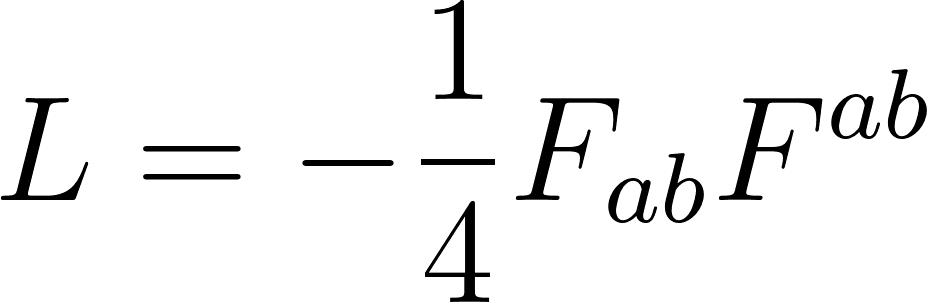
Where the electromagnetic tensor Fab is constituted as a combination of the electric scalar potential and the magnetic vector potential components. The above form is nothing but the difference between the energies of the electric and magnetic fields! This looks suspiciously similar in form to the difference in kinetic energy and potential energy of a particle for the Newtonian mechanics Lagrangian, which hints at deep connections!
22.2 Action Principle Example 4: Einstein’s Laws
To take a little more extreme example, we will consider the Einstein-Hilbert Action:
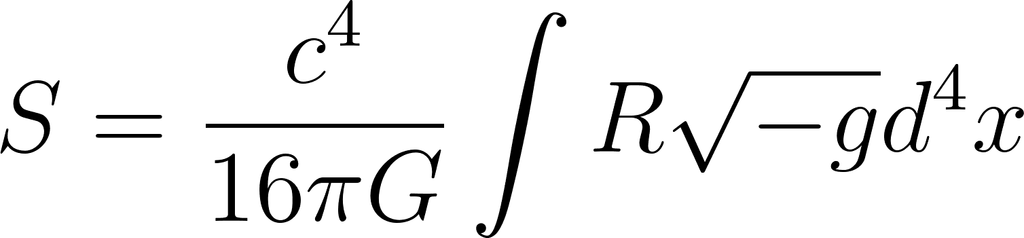
whose Euler-Lagrange equations result in the Einstein field equations of general relativity:
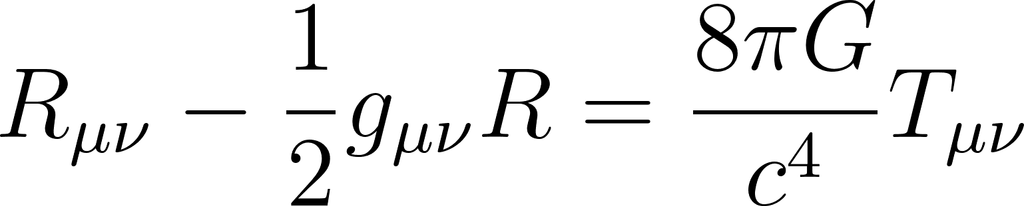
This is the tersest way possible to derive the Einstein equations! This was not the way that Einstein derived them. So, what is the Action Principle stating here? It is stating that the invariant form of the Ricci scalar is minimized. What is the Ricci scalar? In Riemannian geometry, the scalar curvature (or the Ricci scalar) is the simplest curvature invariant of a Riemannian manifold. To each point on a Riemannian manifold, it assigns a single real number determined by the intrinsic geometry of the manifold near that point. Specifically, the scalar curvature represents the amount by which the volume of a small geodesic ball in a Riemannian manifold, deviates from that of the standard ball in Euclidean space. Thus, the Lagrangian of the Action Principle is just the Ricci scalar. So, the Action principle implies a higher order or more unified type of equation from which the Einstein field equations naturally fall out and the added benefit is that there is an implied will attributed, that of conserving the Ricci scalar. This is similar to the idea that the shape of a soap bubble is spherical since the surface area tends to be conserved there.
22.3 Action Principle Example 5: Standard Model of Physics
Our final example is the Standard model of Physics itself which is the most complete theory we have of matter (not including gravity). (In fact, the unification of Gravity into the standard model of physics is the holy grail of physicists as of 2020.) The Lagrangian of Standard Model of Physics looks like this:

The 1st term is the scalar product of the field strength tensor containing the mathematical encoding of all interaction particles except the Higgs boson.
The 2nd term describes how interaction particles interact with matter particles. This contains the Dirac term describing Spinor fields.
And so on.
We can see how beautiful this equation is! All known laws of matter seemingly derive their will from these equations! Absolutely no free will, the universal will directing all particles independent of space and time by just minimizing this Action!
Admittedly, the Action itself is not something immediately given. It is a synthesis using intuition and trial and error (Gödel anyone?). However, the Euler-Lagrange equations consequently arrived at, need to correspond to behavior of the observable under consideration. It is possible that different Actions can give the same result, although this is not serious and need not detain us – the simplest example being that of Actions differing by a constant.
22.4 Life as an oscillator (To be developed)
Life results from replication and mutation at various levels. A crude way to model life is to look at this replication as a positive feedback cell with a gain greater than unity. Darwin’s selective adaptation can be modeled as multiple resonators where a resonator represents a set of conditions to flourish. So, life can be very crudely modeled as multiple oscillators weakly interacting with each other with each frequency representing a different species and it self-originates from simpler materials (amino acids for example). This is not different from the way an oscillator is modeled, as an amplifier with positive feedback that amplifies its own noise at the resonant frequency determined by any associated resonator. This view is appealing for the following several reasons:
22.4.1 Life originates from matter.
22.4.2 The reason for the wide variety of life is easily understandable.
22.4.3 Life is almost a continuous spectrum of life energy
22.4.4 The interaction between life can also be modeled using coupled resonators.
22.4.5 It is a fairly simple model and amenable for easy computer implementation
References:
- Goetz at all, Compassion: An evolutionary analysis and empirical review
- http://nuffieldbioethics.org/wp-content/uploads/Animals-Chapter-4-The-Capacity-of-Animals-to-Experience-Pain-Distress-and-Suffering.pdf
- A. J. Ayer, “Language, Truth, and Logic” [1935]
- Skyhooks and Cranes of Daniel C Dennett
- Hirsh, J. B., Mar, R. A., & Peterson, J. B. (2012, January 16). Psychological Entropy: A Framework for Understanding Uncertainty-Related Anxiety. Psychological Review. Advance online publication. doi: 10.1037/a0026767
- Fanelli D. 2019 A theory and methodology to quantify knowledge.R. Soc.open sci.6: 181055.http://dx.doi.org/10.1098/rsos.181055